
The demo went brilliantly. The AI assistant answered customer questions in seconds, leadership was impressed, and someone said, “Let’s roll this out everywhere.”
Six months later, it still runs for one team, on one data set, with one engineer quietly keeping it alive.
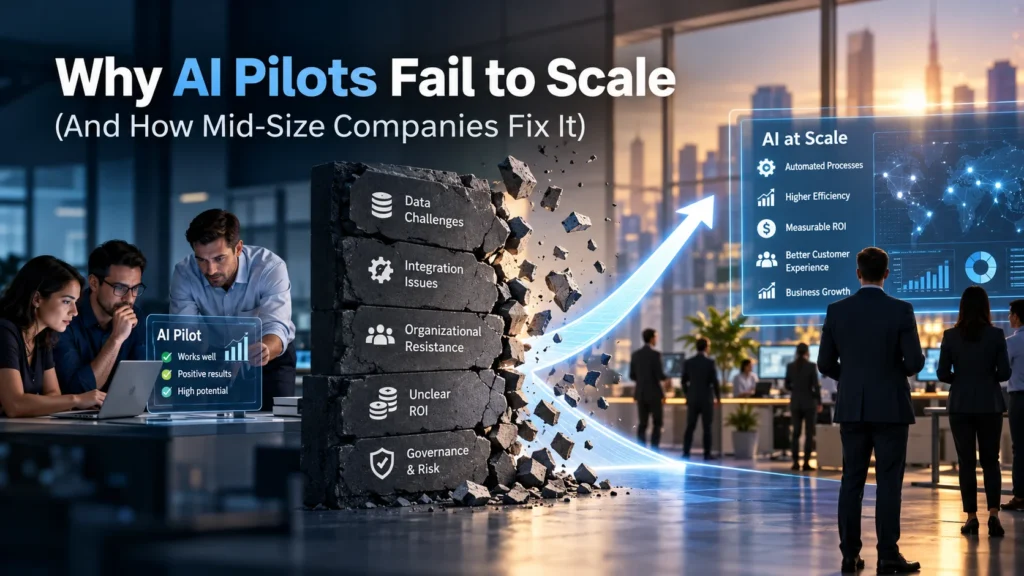
If that sounds familiar, you’re not alone. Most mid-size companies in the US have already proven that AI can work. Their real problem is scaling AI pilots into something the whole business runs on, every day, with numbers the CFO trusts.
This article explains why that gap exists, what actually holds pilots back, and how to move from a promising test to measurable results without wasting another budget cycle.
1. The Middle Market Has Moved Past “Does AI Work?”
For US mid-size companies, the AI debate has changed. The question is no longer whether AI works. It’s why it isn’t working everywhere yet.
In March 2026, RSM surveyed 1,030 leaders at US and Canadian middle market companies (annual revenue of $30 million to $10 billion in the US). The RSM Middle Market AI Survey 2026 found that 86% have partially or fully integrated AI into their operations, and 97% report moderate or high success from AI pilots run over the past two years.
That sounds like a finished story. It isn’t.
The same survey found that 45% of these companies are focused on using AI where it delivers clear value today, while only 17% are pursuing transformation across the whole enterprise. RSM’s own conclusion is blunt: the biggest barrier is no longer whether to invest in AI, but whether the organization is operationally ready to make it work at scale.
McKinsey’s global State of AI 2026 survey points the same way. Among organizations with at least $1 billion in revenue, 54% report scaling AI across the enterprise, compared with about one-third of smaller organizations. And the share of respondents who attribute any EBIT impact to AI has barely moved in a year, at 37%.
Put simply, plenty of companies have AI that works. Far fewer have AI that changes the numbers.
2. Why AI Pilots Succeed in Isolation but Break in Real Operations
A pilot is designed to win. That’s not a criticism; it’s how pilots work. But the conditions that make a pilot succeed are often the same ones that hide what will break later.
Think about a typical invoice-processing pilot. The team picks 200 clean invoices from familiar suppliers. A motivated champion checks every output. Results are copied into the ERP by hand. Accuracy looks excellent, and everyone moves on.
Now scale it. Suddenly the system faces 4,000 invoices a month, scanned at odd angles, from hundreds of suppliers, in formats nobody tested. It has to post directly into the ERP, follow approval rules, and respect who is allowed to see what. The champion has gone back to their day job, and nobody owns the exceptions.
The AI model didn’t get worse. The environment got real.
What a pilot usually skips
- Live data: pilots run on a hand-picked sample, not the messy feed from your CRM, ERP or inbox.
- Integration: outputs are copied manually instead of flowing into the systems people actually use.
- Ownership: a project team runs the pilot, but no business team owns the result afterwards.
- Real success metrics: the pilot proved accuracy, not hours saved, cost per transaction or revenue impact.
- Cost at volume: a few thousand test runs are cheap; millions of runs a year are a budget line.
This is why McKinsey’s research matters here. Among its “AI high performers” (organizations attributing at least 5% of EBIT to AI), nearly three-quarters report fundamentally redesigning workflows around AI. Only a quarter of other respondents say the same. The winners don’t bolt AI onto old processes. They rebuild the process around it.
Proof from the field: Klarna, McDonald’s and Morgan Stanley
Three well-known companies show the gap between a winning pilot and a business that runs on AI.
Klarna: strong pilot numbers, then a quality correction. In February 2024, Klarna launched an AI customer service assistant built on OpenAI. In its first month, according to OpenAI’s Klarna case study, it handled 2.3 million conversations (two-thirds of Klarna’s customer service chats) and did the equivalent work of 700 full-time agents. Customers resolved issues in under 2 minutes instead of 11, repeat inquiries fell 25%, and Klarna estimated a $40 million profit improvement for 2024.
Then the picture changed. In May 2025, CEO Sebastian Siemiatkowski told Bloomberg that Klarna was hiring human customer service agents again. He said the AI was cheaper but had led to lower-quality service, and that customers should always be able to reach a human if they want one.
The lesson: Klarna measured speed and volume brilliantly. It didn’t give quality and the human hand-off the same weight until customers noticed.
McDonald’s: a 100-restaurant pilot that never scaled, then a rebuild. McDonald’s tested AI voice ordering in its US drive-thrus with IBM from 2021. In June 2024, it told franchisees it would switch the technology off in the more than 100 test restaurants by July 26, 2024, ending the test without any expansion. The goal had been faster service and simpler operations, but the industry was asking whether order accuracy was ready.
In 2026, McDonald’s tried again with a very different setup. Its new ArchIQ platform, built with Google, runs on edge computers inside each restaurant and links voice ordering to inventory tracking, kitchen equipment monitoring and scales that check orders are complete. McDonald’s says its voice assistant was more than 90% accurate in early tests and that the drive-thru tools can save each restaurant over 50 hours of staff time a week. These are company-reported figures, and the rollout is staged from 2027.
The lesson: the first attempt was a voice bot added to the old drive-thru. The second treats AI as part of the restaurant’s operating system, with infrastructure and integration built first.
Success story: Morgan Stanley went from pilot to firmwide use. Morgan Stanley Wealth Management built an internal AI assistant with OpenAI so advisors could find answers across the firm’s research and procedures. Before deploying any use case, it tested the AI against expert answers, ran daily regression tests for compliance, and secured zero data retention for its data. It then added a meeting tool that drafts client notes straight into the CRM for advisors to review.
The results, as reported in OpenAI’s Morgan Stanley case study, are clear: over 98% of advisor teams use the assistant, access to documents rose from 20% to 80%, and client follow-ups that used to take days now happen within hours.
The lesson: Morgan Stanley tackled data, integration, measurement and governance before it scaled. That’s why people actually use it.
3. The Four Barriers to Scaling AI Pilots (and How to Fix Each)
RSM asked companies whose pilots had only moderate or limited success what was stopping them from scaling. Four answers led the list: data quality (53%), integration challenges (47%), unclear ROI (33%), and security and compliance concerns (33%). Here’s what each one looks like in practice, and what to do about it.
Barrier 1: Your data isn’t ready for production
The pilot worked on a clean extract. Production runs on whatever your systems actually contain: duplicate customer records, missing fields, three spellings of the same product.
The fix: don’t launch a company-wide data cleanup. Clean only the data that this one use case touches, set rules for keeping it clean, and assign someone to own it. A narrow, well-kept data set beats a grand data strategy that never finishes.
Real example: early tests of Klarna’s assistant found it largely repeated answers from existing documentation and passed customers to human agents quickly. An AI system can only be as good as the knowledge it draws on.
Result to expect: fewer exceptions and manual corrections once the data behind the use case is clean. Track the exception rate every week; when it stops falling, your data is ready to scale.
Barrier 2: The AI doesn’t connect to the systems people use
If your team has to open a separate tool, copy an answer and paste it into the CRM, adoption will fade within weeks. AI that lives outside the workflow becomes optional, and optional tools get ignored.
The fix: design the integration before you scale, not after. Decide where the output lands (the ERP, the helpdesk, the CRM record), what triggers the AI, and what happens when it’s unsure. Legacy systems are rarely a dead end; most can be connected through APIs or middleware with careful scoping. Our AI integration guide covers this in more depth.
Real example: McDonald’s first drive-thru AI was a voice layer on the existing setup, and it was switched off in 2024. Its 2026 system connects ordering to inventory, kitchen equipment and order-checking scales, running on hardware inside each restaurant. McDonald’s says those drive-thru tools can save each restaurant more than 50 hours of staff time a week.
Result to expect: the copy-paste and hand-off time between systems disappears. Measure how long a task takes end to end, not just the AI step, and expect the biggest gain where people used to re-key data.
Barrier 3: Nobody can prove the ROI
Many pilots measure the wrong thing. “The model is 92% accurate” doesn’t tell a CFO whether to fund a rollout.
The fix: before scaling, agree on two or three business metrics, and capture the baseline today. Good examples are cost per processed document, average response time, hours of manual work per week, or conversion rate. Then compare the pilot against that baseline. If you can’t measure a before, you’ll never convincingly prove an after. Our article on rethinking AI spending explores this further.
Real example: the US General Services Administration claimed its automation bots saved more than 240,000 work hours a year. Its inspector general called that claim inaccurate and unreliable. In a sample of 10 bots, one saved no time, and another’s savings assumed a 90-minute manual task that actually took 30 minutes. GSA also wasn’t tracking what the bots cost.
Result to expect: a business case that survives scrutiny. When savings are measured against a real baseline, leadership can approve the next wave with confidence instead of debating the numbers.
Barrier 4: Security and compliance arrive too late
A pilot can quietly bypass access controls. A production system can’t. When legal, IT security or compliance first see the project at rollout stage, it often stalls for months.
The fix: bring them in during the pilot. Document what data the AI can access, where that data is processed, who can see the outputs, and how decisions are logged. The good news: RSM found 67% of middle market companies already apply AI governance controls before the pilot or production stage. If you aren’t one of them, start now; it’s far cheaper than retrofitting.
Real example: Morgan Stanley tested every AI use case before deployment, ran a daily regression suite of sample questions to keep outputs compliant, and secured zero data retention so its proprietary data wouldn’t be used to train public models. Advisors also review AI-drafted notes before they’re final.
Result to expect: faster sign-off for rollout and higher adoption, because people trust the system. At Morgan Stanley, over 98% of advisor teams now use the assistant.
4. The People Gap Nobody Budgets For
Here is the number that should worry leadership teams most: in RSM’s survey, 85% of respondents agree that executive leadership is more enthusiastic about AI than employees are.
That gap matters more than any model choice. A pilot can succeed with a few enthusiastic volunteers. A rollout needs hundreds of people who didn’t ask for it to change how they work.
The strain is real, too. McKinsey found that 47% of mid-level managers and individual contributors report experiencing at least one negative effect from AI at work, compared with 31% of executives and senior managers. The people furthest from the boardroom feel the change most.
How to close it
- Involve the frontline during the pilot. The people who do the work know where the exceptions hide. Their input makes the system better and turns them into advocates.
- Solve their problem, not just yours. Leadership wants lower costs. Employees want fewer repetitive tasks and less chasing. Design for both.
- Train on the workflow, not the tool. “Here’s how your Monday changes” lands better than a product demo.
- Define the human role clearly. Decide what the AI handles alone, what it drafts for review, and what stays with people. Uncertainty breeds resistance.
- Be honest about roles. RSM found 88% of leaders expect their workforce to look fundamentally different within two to three years. Teams sense this. Clear communication builds more trust than silence.
5. AI, Automation or Both? Choose Before You Scale
One of the most expensive scaling mistakes is using AI where simple automation would do the job better.
AI is excellent at interpreting messy, unpredictable inputs: free-text emails, varied documents, customer questions phrased a hundred ways. But if a step follows fixed rules (“if the invoice is under $500 and the PO matches, approve it”), traditional automation is cheaper, faster and easier to audit.
Cost makes this choice more important at scale. McKinsey found that about one in five organizations say AI operating costs, including token costs, have already constrained their AI use. Every step you send to a model when a rule would do adds to that bill.
| Approach | Best for | Real example | Reported result |
|---|---|---|---|
| Rules-based automation | Predictable, repetitive steps with clear rules | The State of Tennessee used 120+ software bots for routine tasks such as time and attendance and verification across more than a dozen agencies (StateScoop) | More than 100,000 hours of annual work automated; reusable automations built in 4–6 weeks versus 2–4 months for custom ones |
| AI | Unstructured inputs and judgment calls | Klarna’s assistant answers customer questions about refunds, returns and payments in 35+ languages (OpenAI) | Resolution time cut from 11 minutes to under 2 in the first month |
| Hybrid (AI + automation + human review) | Most real business processes | Octopus Energy’s AI drafts customer emails, and a team member reviews each one before it’s sent (TheWrap) | The workload of about 250 people, with 80% customer satisfaction for AI-drafted replies versus 65% for human-written ones |
These results are self-reported by each organization, so treat them as direction, not a promise. Your own baseline is the only number that proves your case.
In our experience, most processes that scale successfully end up hybrid. AI handles the messy part, automation handles the predictable part, and people handle the decisions that carry real risk. If you’re weighing this choice, our guide to workflow automation vs AI agents walks through it in detail.
6. The Full Cost of Scaling AI
The tool or model subscription is usually the smallest line in the budget. Scaling costs show up in four places, and the last one never stops.
| Cost | What it covers | Often missed |
|---|---|---|
| Setup | Discovery, workflow design, building and configuring the solution, testing against real cases | Testing on live, messy data, not just the pilot sample |
| Integration | Connecting AI to your CRM, ERP, helpdesk or databases; cleaning the data it depends on; security review | Legacy systems that need middleware or API work before anything connects |
| Training and change | Teaching teams the new workflow, updating procedures, time for frontline feedback | The productivity dip while people learn, and time from managers to lead the change |
| Monthly running costs | Model or token usage, hosting, licences, monitoring, human review of exceptions, ongoing fixes | Usage that grows with volume, and the people needed to review and maintain the system |
Two real examples show why this matters:
- Running costs grow with success. McKinsey found about one in five organizations say AI operating costs, including token costs, have already constrained their AI use.
- Automation needs a standing budget, not just a launch budget. Tennessee’s automation program began with $10 million in funding in 2020, and the state CIO’s office then secured $5 million every year for a dedicated automation team.
Before you approve a rollout, ask for a cost estimate at full volume over at least three years, covering all four lines above. Then compare it with the savings you measured against your baseline. If a vendor or partner can only quote the build, you don’t yet have the full picture.
7. A Pilot-to-Production Readiness Checklist
Before you approve a rollout budget, run your pilot through these questions. If you can’t answer “yes” to most of them, the next investment should go into readiness, not scale.
Business case
- We have a baseline for two or three business metrics, measured before the pilot.
- The pilot moved those metrics, not just model accuracy.
- We know the expected running cost at full volume, not just the build cost.
Data and integration
- The AI has been tested on live, messy data, not only a curated sample.
- Outputs flow directly into the systems people already use.
- Someone owns the quality of the data this use case depends on.
Process and people
- The workflow has been redesigned around AI, not just extended with it.
- It’s clear what the AI does alone, what it drafts for review, and what stays human.
- A named business owner (not just IT) is accountable for results.
- Frontline users helped shape the pilot and have been trained on the new workflow.
Risk and governance
- Security, legal and compliance have reviewed data access and outputs.
- Decisions and outputs are logged so they can be audited.
- There is a plan for when the AI is wrong or unsure.
A practical tip: scale in waves. Expand to one more team or region, measure again against the baseline, fix what breaks, then expand further. It feels slower, but it’s far cheaper than a big-bang rollout that quietly fails.
8. How Equitysoft Helps Mid-Size Companies Scale AI
Most stalled pilots don’t need a new model. They need the unglamorous work around it: cleaner data, solid integrations, a redesigned workflow and metrics leadership can trust.
That’s where Equitysoft Technologies focuses. We work as a technology consulting and implementation partner, so the same team that assesses your pilot can also build what it needs to scale. That typically means:
- Reviewing the pilot honestly: what it proved, what it didn’t, and whether it’s worth scaling at all.
- Choosing the right approach: AI, workflow automation or a hybrid, based on cost and risk rather than hype.
- Connecting AI to your systems: integrating AI with your CRM, ERP, helpdesk and internal tools so outputs land where work happens.
- Rolling out in measured waves: with baselines, success metrics and governance built in from the start.
If you have an AI pilot that worked but hasn’t spread, the next step is simple. We’ll review your pilot against the readiness checklist above, flag the gaps in data, integration, cost and governance, and tell you honestly whether it’s worth scaling.
9. Conclusion: Should You Scale Your AI Pilot?
So, should you scale your AI pilot? Here’s a straight answer.
Yes, scale it if:
- It moved a business metric you measured before the pilot, not just model accuracy.
- It has been tested on live, messy data and still holds up.
- Its output flows straight into the systems your team already uses.
- You’ve costed it at full volume, including integration, training and monthly running costs, and the savings still win.
- A named business owner is accountable, and security and compliance have signed off.
Not yet, if:
- You can’t show a before-and-after number your CFO would accept.
- People still copy and paste the AI’s output into other tools.
- Nobody has priced the running costs at full volume.
- The frontline team hasn’t used it, or doesn’t trust it.
- There’s no clear path to a human when the AI is wrong or unsure.
“Not yet” doesn’t mean “never.” McDonald’s paused, rebuilt its foundations and came back stronger. Klarna brought human agents back so customers can always reach a person. Morgan Stanley did the groundwork first and earned near-universal adoption.
Your pilot probably didn’t fail. It just hasn’t been given an operating model yet. Build that, scale in measured waves, and the results that impressed everyone in the demo can finally show up across the business.
10. FAQs
Sources
- RSM Middle Market AI Survey 2026: U.S. and Canada (news release, July 21, 2026) — 1,030 respondents, surveyed March 5–16, 2026
- McKinsey, The state of AI in 2026: On the road to ROI (August 25, 2026) — 1,719 respondents in 97 countries, surveyed May–June 2026
- OpenAI, Klarna customer story — first-month results of Klarna’s AI assistant (launched February 2024)
- Entrepreneur, Klarna is hiring customer service agents again (May 9, 2025) — reporting on the CEO’s Bloomberg interview
- Restaurant Business, McDonald’s is ending its drive-thru AI test (June 2024)
- The Next Web, McDonald’s tests Archy (September 26, 2026) — company-reported accuracy and time-saving figures
- OpenAI, Morgan Stanley customer story — vendor case study
- FEDweek, GSA inspector general report on automation savings (December 5, 2023)
- StateScoop, RPA saving Tennessee 100,000 hours of annual work (May 2, 2023)
- TheWrap, Octopus Energy AI customer emails (May 9, 2023)