

AI has become one of the most powerful tools businesses can use to boost productivity, lower costs, and deliver exceptional customer experiences. With modern AI for business and advanced AI solutions, companies can unlock new levels of efficiency. From small startups to large enterprises, companies that integrate AI into their operations are able to work faster, make more accurate decisions, and scale efficiently without increasing manual effort. This type of AI integration and business automation is transforming industries worldwide.
Today, businesses rely on AI for:
- Automating repetitive tasks
- Predicting customer behavior and needs using predictive analytics and machine learning for business
- Improving sales conversions and lead quality
- Reducing operational errors
- Managing inventory with better accuracy
- Personalizing marketing campaigns with AI-powered marketing
- Detecting fraud and security risks through AI fraud detection
- Enhancing customer service and support using AI customer support tools
These AI-driven improvements result in higher revenue, lower expenses, and a strong competitive edge.
In fact, companies that adopt AI early consistently experience AI-driven growth and scale faster than those that delay or avoid AI technology.
Key Insights
1. AI boosts business performance
AI improves all departments simultaneously, increasing productivity by 20–35% and reducing operating costs by 15–30%.
2. AI is easy to start
Modern AI tools are affordable, simple to set up, and can deliver measurable results within weeks, even when used with existing systems.
3. AI helps businesses scale
AI automates repetitive tasks, enabling companies to grow workload capacity by 40–60% without adding extra staff.
4. AI improves customer understanding
AI analyzes customer behavior to personalize experiences, helping businesses reduce churn by up to 25% and increase loyalty.
5. AI reduces errors
AI minimizes human mistakes and enhances forecasting accuracy, cutting operational errors by 30–50% across departments.
Why AI Matters TODAY More Than Ever
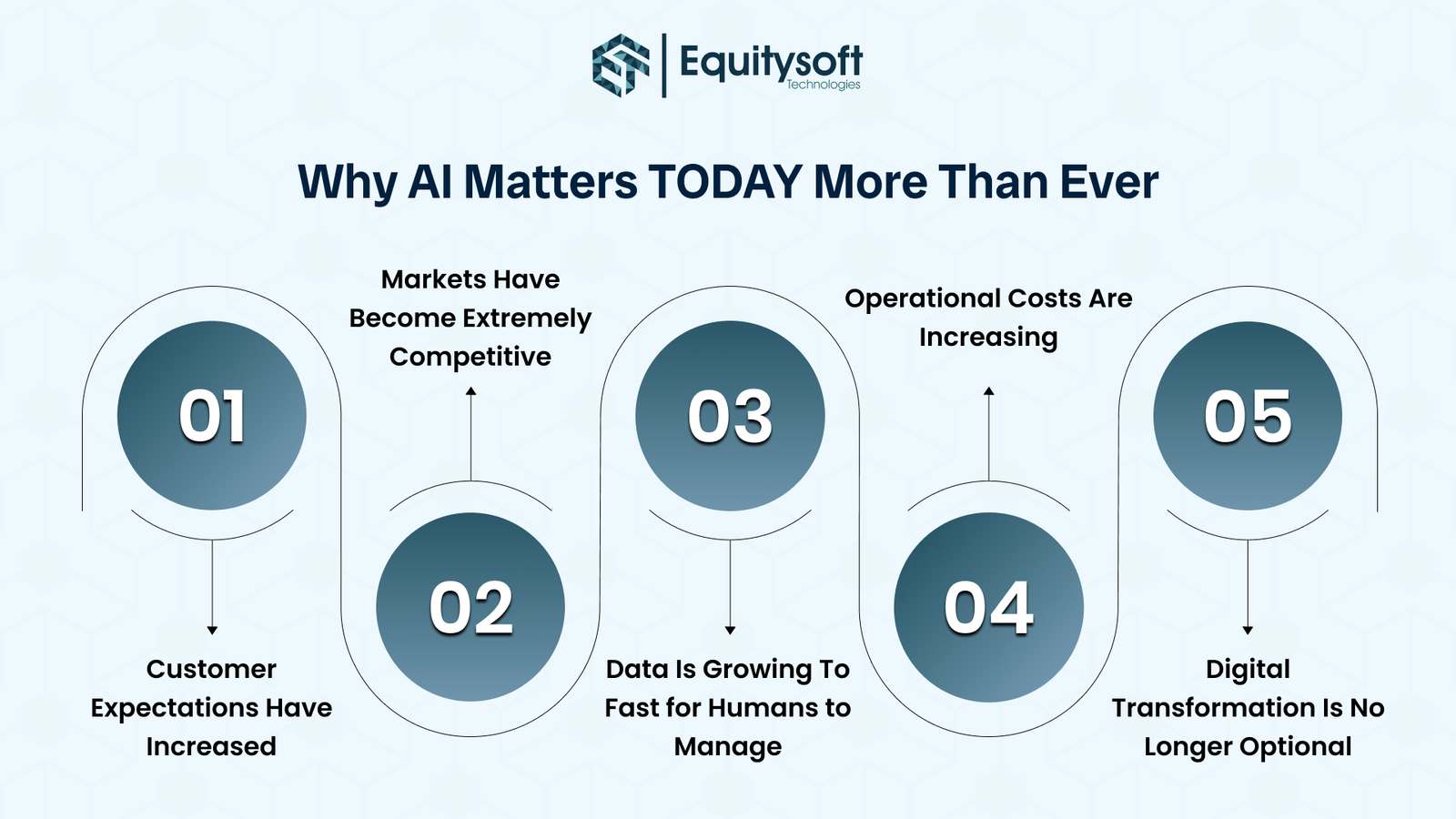
The past five years have transformed business completely changing customer expectations, increasing competition, multiplying data, and making AI for business an essential requirement rather than a future option. Rapid AI adoption and AI transformation are now critical for companies that want to stay competitive.
1. Customer Expectations Have Increased
Customers now expect instant replies, 24/7 support, fast deliveries, and personalized experiences and AI-powered personalization, automation, and machine learning enable these at scale far beyond what manual teams can handle.
2. Markets Have Become Extremely Competitive
Competition is now global, and companies using AI integration operate faster, predict customer needs better, and deliver superior experiences leaving non-AI businesses at a major disadvantage in overall business competitiveness.
3. Data Is Growing Too Fast for Humans to Manage
Businesses generate massive volumes of data daily, and only artificial intelligence can process it instantly, uncover hidden patterns, predict behavior, and support smarter, faster data-driven decisions.
4. Operational Costs Are Increasing
With rising labor and operational expenses, AI automation reduces costs by automating routine tasks, minimizing errors, boosting productivity, and managing large workloads without additional staff making AI cost reduction essential for modern businesses.
5. Digital Transformation Is No Longer Optional
Most customers engage digitally first, and AI in digital transformation enhances these experiences through personalization, automated support, targeted marketing, and smarter recommendations building stronger trust and loyalty.
Market Growth Data
- The global AI industry is projected to reach $270 billion by 2030.
- AI adoption is accelerating at an impressive 35% yearly growth rate.
- This rapid expansion shows that businesses worldwide are shifting to AI-powered operations and early adopters will gain the strongest competitive advantage.
What Is Using AI to Transform Your Business?
AI transformation means integrating intelligent technologies into your business so systems can learn from data, make predictions, automate tasks, and support decision-making. Instead of relying only on manual work, AI integration speeds up operations, reduces errors, and improves overall performance. It helps businesses understand patterns, predict outcomes, automate repetitive processes, and enhance efficiency across every department making companies faster, more accurate, and more scalable through artificial intelligence in business.
Business Meaning of AI
From a business perspective, AI for business growth helps companies run smarter and more efficiently by reducing time spent on routine work, improving customer satisfaction with personalized support, assisting employees with data-backed insights, identifying issues early, and predicting future needs or trends. In simple terms, business AI systems enable companies to grow with fewer mistakes, less manual effort, and better decision-making through AI automation and advanced analytics.
Technical Meaning of AI
AI is powered by core technologies that work together to enhance intelligence and automation:
- Machine Learning (ML): Systems that learn from data and improve over time (machine learning for business).
- Natural Language Processing (NLP): Technology that understands and responds to human language (chatbots, voice assistants, etc.) a key part of NLP technology.
- Computer Vision: Systems that interpret images and videos to detect objects, text, or patterns, enabling powerful computer vision solutions.
- Automation Engines: Tools that perform tasks automatically, such as document processing or email sorting, forming the backbone of AI-powered operations.
Combined, these technologies help businesses operate with speed, accuracy, and intelligence, replacing guesswork with data-driven decision-making.
Why Companies Use AI
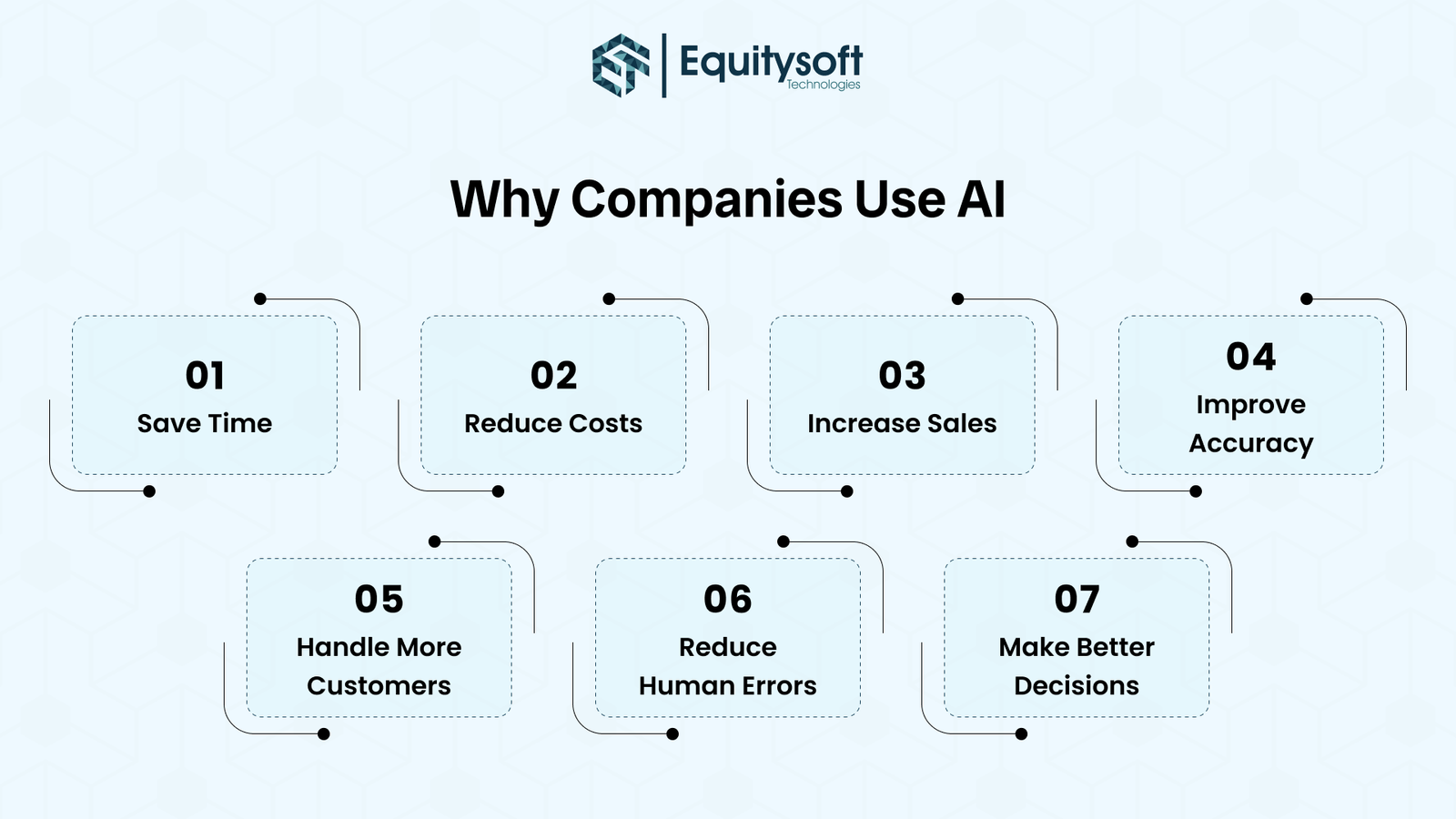
Companies adopt AI for business because it delivers practical, measurable improvements across every part of the organization. Below are the key reasons AI adoption has become essential for modern businesses:
1. Save Time
AI automates repetitive and time-consuming tasks such as data entry, reporting, scheduling, and customer support, allowing employees to focus on strategic and high-value work instead of routine manual activities. This AI automation dramatically increases productivity.
2. Reduce Costs
By automating labor-heavy tasks and reducing errors, AI lowers operational expenses significantly. Work that previously required multiple employees can now be completed faster and more accurately by AI systems, delivering strong AI cost reduction benefits.
3. Increase Sales
AI analyzes customer behavior and buying patterns to recommend the right products at the right moment, resulting in higher conversions, improved targeting, and stronger customer retention. This makes AI sales optimization a powerful tool for growth.
4. Improve Accuracy
AI operates with data-driven precision, reducing errors in forecasting, documentation, inventory management, customer service, and overall decision-making. Businesses benefit from higher AI accuracy and more reliable outcomes.
5. Handle More Customers
With AI chatbots, virtual assistants, and automated workflows, businesses can serve a larger volume of customers without adding extra manpower, improving responsiveness and AI scalability in customer service operations.
6. Reduce Human Errors
AI minimizes mistakes caused by fatigue or manual processing by consistently following rules and analyzing data accurately, improving quality and reliability across departments, one of the strongest artificial intelligence benefits.
7. Make Better Decisions
AI converts raw data into clear insights using machine learning insights, helping businesses predict trends, optimize operations, identify risks, and make profitable, data-driven decisions with confidence.
Real-World Analogy: AI as the GPS of a Business
Running a business without AI is like driving a car without GPS. You can reach your destination, but it takes longer, you’re more likely to take wrong turns, you have no visibility into the fastest or safest route, and you cannot predict traffic or delays. AI acts as the GPS of a business by guiding decisions with real-time intelligence, showing the most efficient path, highlighting potential risks, and helping the organization move faster, smarter, and with greater confidence.
Real Example: Retail Brand Success with AI
A retail company used AI to analyze its sales and customer data. The AI system identified:
- Customers most likely to return
- Products expected to be in high demand the following month
By using AI-driven predictions and recommendations, the company achieved:
-
22% increase in repeat purchases
AI identified high-value customers and delivered personalized offers. -
15% reduction in overstock costs
AI accurately predicted demand, helping avoid excess inventory.
Better insights → Better decisions → Better business results
Why AI in Business Matters Today
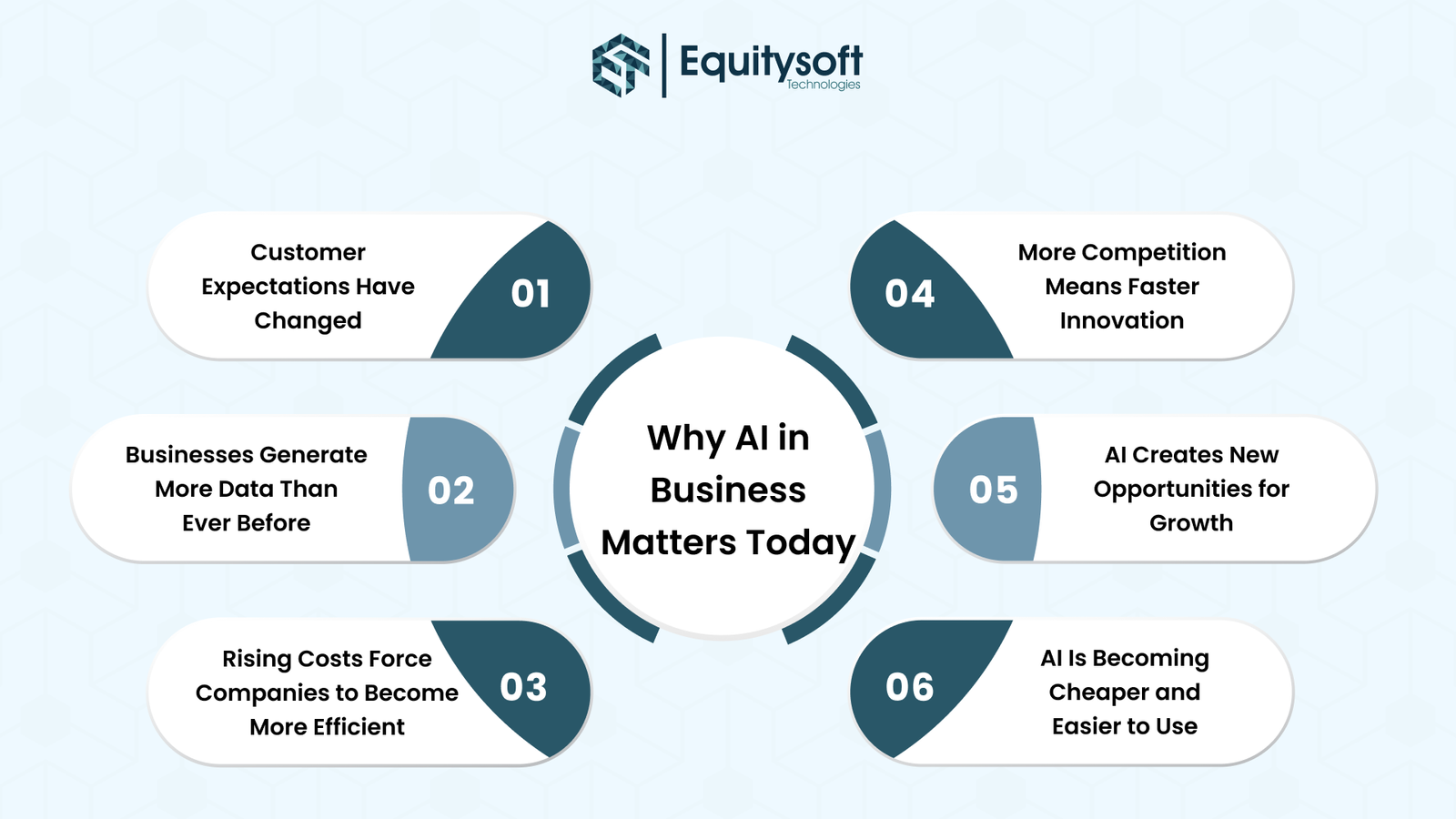
AI in business is accelerating because today’s business environment is more complex, competitive, and data-heavy than ever. Here are the key reasons AI adoption has become essential for modern organizations:
1. Customer Expectations Have Changed
Customers now expect instant responses, personalized experiences, seamless digital interactions, smart suggestions, and real-time updates. AI customer experience tools enable businesses to meet these expectations at scale without increasing team size, ensuring fast, consistent, and high-quality service across all touchpoints.
2. Businesses Generate More Data Than Ever Before
Companies produce enormous volumes of data through websites, sales systems, CRM tools, support interactions, social media, and product usage. Human teams cannot analyze this manually, but data-driven AI can process large datasets instantly, uncover hidden patterns, and deliver actionable insights that support smarter, faster decision-making.
3. Rising Costs Force Companies to Become More Efficient
Operational and labor costs are increasing globally, making efficiency a necessity. AI automation reduces expenses by automating repetitive work, improving marketing accuracy, minimizing inventory waste, preventing operational errors, and reducing customer churn helping businesses maintain profitability while improving performance and overall AI efficiency.
4. More Competition Means Faster Innovation
Industries move quickly, and companies using AI transformation can respond faster, target customers more precisely, forecast trends more accurately, and launch new features sooner. Businesses that delay AI adoption fall behind competitors who operate smarter, faster, and more efficiently gaining a strong competitive advantage with AI.
5. AI Creates New Opportunities for Growth
AI enables innovation by opening doors to new revenue streams, new product ideas, personalized service models, deeper customer insights, and advanced automation. It becomes a driver of AI-powered growth, not just a tool for reducing costs helping businesses scale in entirely new ways.
6. AI Is Becoming Cheaper and Easier to Use
AI no longer requires huge budgets or specialized teams. With no-code tools, cloud-based AI services, easy API integrations, and pre-trained models, businesses of all sizes from startups to enterprises can adopt scalable AI solutions quickly, affordably, and with minimal technical barriers. Modern AI tools make implementation accessible and fast.
Why AI Benefits Businesses
AI helps companies operate faster, smarter, and more accurately while reducing costs and strengthening competitive advantage. Below are the 10 most important benefits, each explained briefly with real examples.
1. AI Greatly Improves Productivity
AI automates repetitive tasks like data entry, documentation, emails, and reporting, freeing employees for strategic, creative work. It speeds up operations and reduces errors.
Example: A logistics company cut an 8-hour task to 45 minutes using AI, boosting team capacity by 60%.
2. AI Improves Customer Experience and Satisfaction
AI chatbots and recommendation engines deliver instant, personalized, and 24/7 support, improving retention and reducing frustration.
Example: An e-commerce brand reduced response time from 6 hours to 10 minutes, increasing satisfaction by 27%.
3. AI Reduces Operational Costs
By automating manual tasks, preventing errors, and optimizing resources, AI lowers labor, marketing, and inventory costs.
Example: A finance company reduced staffing needs by 40% through AI-based document verification.
4. AI Helps Make Smarter Decisions
AI analyzes large datasets, detects trends, and predicts outcomes, enabling leaders to make fact-based decisions instead of assumptions.
Example: A retail chain improved demand accuracy by 30% and reduced stockouts using AI forecasting.
5. AI Boosts Sales and Marketing Performance
AI predicts customer behavior, scores leads, and personalizes marketing messages, increasing conversions and ROI.
Example: Sales teams using AI lead scoring achieved 25–45% higher conversion rates.
6. AI Helps Detect Fraud and Reduce Risks
AI identifies suspicious patterns in real time, catching fraud faster and more accurately than manual methods.
Example: Banks using AI reduced fraud cases by 50–70% within a year.
7. AI Improves Inventory and Supply Chain Accuracy
AI uses predictive analytics to maintain optimal stock levels and optimize delivery routes, reducing waste and delays.
Example: A supermarket chain cut inventory waste by 18% using AI demand forecasting.
8. AI Supports Employees Instead of Replacing Them
AI removes repetitive workloads so employees can focus on creative and strategic tasks, improving productivity and job satisfaction.
Example: A support team saved 35 hours per week with AI-powered ticket categorization.
9. AI Eliminates Human Errors
AI processes data consistently and accurately, reducing mistakes that occur due to fatigue or manual handling critical in high-risk industries.
Example:A medical lab reduced diagnostic errors by 70% using AI sample analysis.
10. AI Provides a Strong Competitive Advantage
AI-driven companies operate faster, innovate sooner, and respond to market changes better than competitors, giving them a major edge. Businesses that delay AI adoption risk falling behind.
How AI Works in a Business
AI works by collecting business data, learning from it, identifying patterns, making predictions, and automating tasks. Unlike traditional software that follows fixed rules, AI continuously improves as it receives more data, becoming smarter and more accurate over time.
Step 1: Data Collection (AI’s Foundation)
AI begins by gathering the right data, such as customer interactions, sales records, website behavior, product usage, support tickets, marketing results, inventory logs, and logistics details. High-quality data leads to high-quality predictions.
Example: Retailers achieve stronger demand forecasts when they include seasonal trends and a full year of sales data.
Step 2: Data Preparation (Cleaning & Organizing)
Before AI can learn, data must be cleaned, corrected, and properly structured to remove errors and inconsistencies. Clean data ensures more accurate results.
Example: A bank increased AI accuracy from 62% to 91% after fixing missing income fields and incorrect job titles.
Step 3: Model Training (Teaching AI to Learn)
AI analyzes the prepared data to recognize patterns, predict outcomes, classify information, and recommend actions. The more examples it learns from, the smarter it becomes.
Example: Netflix constantly improves recommendations by learning from billions of user viewing behaviors.
Step 4: Integration (Connecting AI to Business Tools)
AI must be connected to CRMs, ERPs, websites, chat systems, and internal apps so employees can use AI insights in real time.
Example: Sales teams receive lead scores and conversion predictions directly inside their CRM.
Step 5: Automation (AI Performs Tasks Automatically)
Once integrated, AI begins performing tasks on its own responding to customers, categorizing tickets, forecasting sales, updating inventory, and even approving simple applications.
Example: Insurance companies auto-approve 60% of claims using AI, reducing processing costs by 25%.
Step 6: Monitoring & Improvement (Continuous Learning)
AI systems must be monitored and retrained as new data, trends, or customer behaviors emerge to maintain accuracy and relevance.
Example: Food delivery companies retrain their models during festivals when demand patterns shift rapidly.
Step 7: Scaling AI Across Departments
After AI proves successful in one area, it can be expanded across HR, finance, supply chain, operations, sales, and marketing creating a fully AI-powered organization.
Example: Companies that started with simple chatbots reduced overall operational costs by up to 28% once AI was scaled across multiple departments.
Real-World Examples of AI Transforming Businesses
AI in business is solving real challenges across industries. Below are four concise examples of how leading companies use AI transformation to improve performance, reduce costs, and operate at scale.
1. Amazon – AI for Personalization & Logistics
Amazon uses AI personalization, buying behavior prediction, delivery route optimization, and inventory forecasting. As a result, 35% of Amazon’s revenue comes from AI recommendations. Deliveries are faster, inventory waste is lower, and customer satisfaction continues to rise keeping Amazon ahead of competitors through strong AI automation and predictive analytics.
2. Netflix – AI for Content Personalization
Netflix relies heavily on AI case studies in personalization to recommend shows, analyze viewing behavior, customize thumbnails, and forecast content success. This has significantly reduced churn, saved over $1 billion annually, and increased viewer engagement making Netflix feel customized for every user and boosting long-term loyalty.
3. JPMorgan Chase – AI for Document Review
JPMorgan uses AI in financial services to scan legal and financial documents, detect risks, identify fraud, and review contracts instantly. This automation saves 360,000 work hours per year, reduces processing time from hours to seconds, and improves accuracy dramatically lowering compliance costs and operational risks.
4. Walmart – AI for Inventory & Supply Chain
Walmart leverages AI supply chain optimization, demand forecasting, shelf-scanning robots, route planning, and automated inventory management. These innovations have reduced stockouts by up to 30%, improved restocking efficiency, lowered logistics costs, and increased customer satisfaction helping Walmart maintain strong operational performance at massive scale.
Common Problems Businesses Face When Implementing AI
Even with the advantages, many organizations struggle with AI implementation issues. Below are the most common challenges companies face while adopting AI.
1. Poor Data Quality
AI delivers weak or unreliable results when data is incomplete, outdated, or inaccurate, leading to wrong predictions, poor decisions, and financial losses. Data quality in AI is one of the biggest barriers to accurate outcomes.
2. Lack of Skilled Staff
AI implementation requires knowledge of data, machine learning, and system integration. Without skilled staff, adoption becomes slow and execution suffers making AI adoption challenges more complex.
3. Integration Problems
Many organizations rely on legacy systems that don’t easily connect with modern AI tools, resulting in higher setup costs, delays, and technical complexity. AI integration issues often slow down deployment.
4. Cybersecurity Risks
Because AI systems handle sensitive business data, weak security can expose companies to hacking, data breaches, and compliance risks. AI cybersecurity is critical for safe adoption.
5. Regulatory Compliance
AI must comply with laws like GDPR and HIPAA. Mishandling customer data can lead to legal penalties and reputational damage. AI compliance requirements must be followed strictly.
6. AI Bias
If training data includes bias, AI produces unfair or inaccurate outcomes, hurting hiring decisions, customer scoring, and overall brand trust. Managing AI bias is essential for ethical AI use.
7. Employee Resistance
Employees may fear job loss or struggle with new technologies, resulting in low adoption and internal resistance. This is a common AI change management challenge.
8. Unclear ROI Measurement
Without clearly defined KPIs, businesses struggle to measure the success of AI deployments, making it difficult to justify budget and long-term investment. Tracking AI ROI is essential for continued support.
Implementation Strategy
Your AI implementation strategy should follow clear steps to ensure successful adoption, smooth integration, and measurable business impact.
Step 1: Define Clear Objectives
Begin by identifying the exact problem AI should solve whether it’s reducing churn, improving sales, automating customer support, or lowering operating costs. Clear goals lead to stronger results and more effective AI adoption steps.
Step 2: Audit Your Data
Review your data to ensure it is clean, complete, accurate, and stored in a centralized system. High-quality data is the foundation of any successful AI deployment.
Step 3: Choose the Right Technology
Select the AI approach that best fits your business SaaS AI tools, no-code AI, cloud AI platforms, or fully custom AI solutions based on your complexity and budget. This step is essential for proper AI technology selection.
Step 4: Build or Select an AI Model
Develop a custom model aligned with your workflows or choose a pre-built AI tool that integrates smoothly with your existing systems. Effective AI model development ensures accurate predictions and automation.
Step 5: Pilot Test
Start small by implementing AI in one department to validate performance and identify improvements before full-scale deployment. This AI pilot testing phase minimizes risks and boosts success rates.
Step 6: Train Employees
Ensure your team understands how to use AI tools effectively; adoption improves significantly when employees feel confident and supported. Employee AI training is vital for long-term success.
Step 7: Deploy & Monitor
Launch AI into daily operations and continuously track accuracy, efficiency gains, cost savings, and customer impact to maintain performance. Ongoing AI monitoring keeps systems reliable and relevant.
Step 8: Scale Across Departments
Expand AI into HR, finance, operations, sales, marketing, and other departments to achieve organization-wide transformation and maximum ROI. Successful AI integration leads to enterprise-wide value and strong AI ROI.
Tools, Platforms & Technologies
Below is a quick comparison of popular AI tools and platforms used for different business needs:
| Tool / Platform | Best For | Key Features | Limitations |
|---|---|---|---|
| ChatGPT API | Chatbots, automation | Natural language understanding, conversational AI, workflow automation | Requires technical integration |
| Google Vertex AI | Custom machine learning | End-to-end ML training, deployment, model management | Higher technical complexity |
| IBM Watson | Document processing & NLP | Text analysis, automation, enterprise AI solutions | Can be expensive and resource-heavy |
| Microsoft Copilot | Productivity workflows | AI-assisted tasks, document creation, workflow automation | Limited customization options |
| HubSpot AI | CRM & sales optimization | Lead scoring, forecasting, personalized recommendations | Works best only within HubSpot ecosystem |
| Tableau AI | Analytics & insights | AI-driven data analysis, automated insights, dashboards | Not designed for automation or operational tasks |
Cost Breakdown
1. Development Costs
Custom AI development typically ranges from $10,000 to $150,000+, with more complex models requiring higher investment.
2. Tools & Licensing
AI platforms and SaaS tools usually involve ongoing subscription fees, generally between $500 and $5,000 per month depending on scale and usage.
3. Hiring & Team Costs
Specialized roles, such as data scientists, can cost $80,000+ per year, representing a major part of internal AI team expenses.
4. Maintenance
AI systems require regular updates, retraining, and performance monitoring, costing 15–20% of the project cost annually.
5. Hidden Costs
Additional expenses may include data cleaning, integration work, employee training, security and compliance checks, and ongoing support requirements.
Common Mistakes to Avoid When Using AI
1. Starting Without Clear Goals
Businesses often begin AI projects without defining specific objectives, which leads to confusion, poor adoption, and wasted investment. This is one of the most common AI implementation challenges. The solution is to set measurable goals such as reducing response times or improving prediction accuracy to ensure focused and successful outcomes.
2. Ignoring Data Quality
AI depends entirely on accurate, complete, and clean data. Poor data leads to incorrect predictions and bad decisions. Ensuring strong data quality in AI through audits and standardization improves performance and reliability.
3. Choosing AI Tools Without Evaluating Fit
Buying AI tools because they are popular or trending can result in poor performance and integration issues. Proper AI tool selection should be based on business size, use case, industry needs, and data availability to ensure the right fit.
4. Trying to Automate Everything at Once
Rushing into full automation causes overload and confusion. Instead, businesses should start small with a pilot test, measure results, and scale gradually. This is a key AI automation strategy for long-term success.
5. Not Training Employees Properly
AI only works when employees understand how to use it. Without proper training, adoption remains low and resistance increases. Effective AI training programs help teams feel confident, supported, and ready to use AI tools correctly.
6. No Monitoring or Model Updates
AI must be monitored and updated regularly. Without ongoing tuning, accuracy drops and insights become outdated. Continuous improvement is required for strong, reliable AI model updates.
7. Not Considering Cybersecurity Risks
AI systems store sensitive data, making them prime targets for attacks. Weak security can cause data breaches and legal issues. Strong AI cybersecurity measures such as encryption and secure access controls are essential.
8. Misunderstanding AI Capabilities
Some companies expect AI to solve every problem instantly, leading to unrealistic expectations and potential project failure. Understanding AI capabilities and limitations helps teams select achievable use cases.
9. Not Measuring ROI
Without tracking performance, companies cannot determine whether AI is delivering value. Monitoring cost savings, conversions, error reductions, and time saved ensures clear AI ROI measurement.
10. Lack of Long-Term Strategy
AI is not a one-time project; it requires planning for future growth. A 1-year, 3-year, and 5-year long-term AI strategy helps businesses scale responsibly and maximize long-term impact.
Future Trends in AI for Business
1. AI Agents (Digital Employees)
AI agents will act like digital employees, completing full workflows such as generating reports, handling support tickets, managing schedules, and running marketing campaigns. These AI agents will help businesses operate with combined human + AI teams for greater efficiency.
2. Hyper-Personalization
AI will deliver ultra-personalized experiences by customizing website content, product suggestions, email campaigns, and even pricing. This hyper-personalization will increase customer satisfaction and drive higher sales.
3. Predictive Supply Chains
AI will forecast demand, track shipments, and predict delays before they occur. This predictive supply chain optimization will help companies reduce costs, speed up deliveries, and prevent stockouts.
4. Voice-Based Business Management
Leaders will manage operations through voice commands like “Show me this week’s sales forecast” or “Send follow-up emails to warm leads.” Voice AI will respond instantly and execute tasks in real time.
5. Industry-Specific AI Models
AI will evolve into specialized, industry-focused models for healthcare, retail, finance, and manufacturing. These industry-specific AI models will understand terminology, workflows, and regulations more deeply than general AI tools.
6. Autonomous Decision Systems
AI will not only provide insights but also take automated actions adjusting prices, approving low-risk loans, scheduling logistics, and optimizing operations. These autonomous AI systems will dramatically increase speed, accuracy, and efficiency.
Conclusion
AI in business is now a must-have for success. It helps companies work faster, make fewer mistakes, improve decision-making, and reduce costs. Businesses using AI experience major benefits like quicker replies to customers, better engagement, and stronger financial performance.
The best part about AI is that it keeps learning. The more data you give it, the smarter it becomes. This supports discovery of important insights, better planning, and faster growth making AI a core engine for business growth.
Companies that start using AI early already see major improvements in efficiency and customer satisfaction. Those who delay risk losing customers to competitors who use AI to operate smarter and scale without increasing costs.
The future of business will be intelligent, automated, and driven by data. AI is not just a tool, it’s the foundation for long-term business success.
At Equitysoft Technologies, we help businesses start their AI transformation journey easily so they can become stronger, more flexible, and ready for tomorrow’s challenges.
Frequently Asked Questions
Get answers to common questions about AI in eCommerce