

Modern customers expect instant, personalised, and round-the-clock support something traditional call centers struggle to deliver due to staffing limits, long wait times, and rising operational costs. To meet these expectations, businesses are increasingly turning to AI Voice Agents, which provide natural, human-like conversations, understand customer intent, and deliver accurate responses instantly.
With faster resolution, 24/7 availability, and the ability to handle high call volumes effortlessly, AI Voice Agents are becoming a strategic choice for companies aiming to improve customer experience while reducing operational pressure.
Key Takeaways
- AI Voice Agents provide round-the-clock availability, instant responses, and personalized interactions at scale.
- They reduce manpower costs significantly by automating 60–80% of repetitive queries.
- Modern AI agents continuously learn, improving response quality and accuracy with every customer interaction.
- Businesses today need fast, reliable, and contextual support and voice agents meet those expectations better than traditional models.
Why AI Voice Agents Matter Today
Customer expectations have changed dramatically. People want:
- Instant support
- Answers tailored to their needs
- Support available at any time, from anywhere
- Consistent communication across channels
Waiting on hold, dealing with unhelpful IVR menus, or relying on limited human staffing no longer fits today’s expectations.
Organizations across industries retail, telecom, fintech, travel, healthcare, and automotive now use AI Voice Agents to deliver seamless, reliable support experiences.
Real-World Proof
- Sephora: Integrated AI conversational systems for product guidance and recommendations. Result: 30% boost in customer satisfaction.
- Wendy’s: The brand uses an automated AI ordering system, handling over 50,000 orders a day with 95% accuracy across multiple languages.
- Mercedes-Benz: The company built an Automotive AI Agent within their MBUX system, enabling natural, human-like car-to-driver conversations. (Source: Google Cloud)
These examples show that AI isn’t just automating replies it’s powering real-time, personalized, intelligent communication.
The Growing Adoption of AI Agents in Customer Service
The use of AI agents in customer service is rapidly increasing across industries. Recent findings highlight this shift:
- 41% of companies already use AI copilots for customer support.
- 60% of businesses use AI for IT help desk automation.
- The global AI agents market will reach **$50.31 billion by 2030**.
This momentum is driven by several key factors:
- Growing demand for 24/7 customer support
- Rising operational and labor costs
- Advancements in natural language processing (NLP) and speech AI
- Increased workflow automation
- Accelerating digital transformation across industries
As a result, businesses that adopt AI voice agent solutions today are gaining a significant competitive advantage improving operational efficiency, enhancing customer satisfaction, and building stronger long-term loyalty.
How AI Voice Agents Work in Customer Support
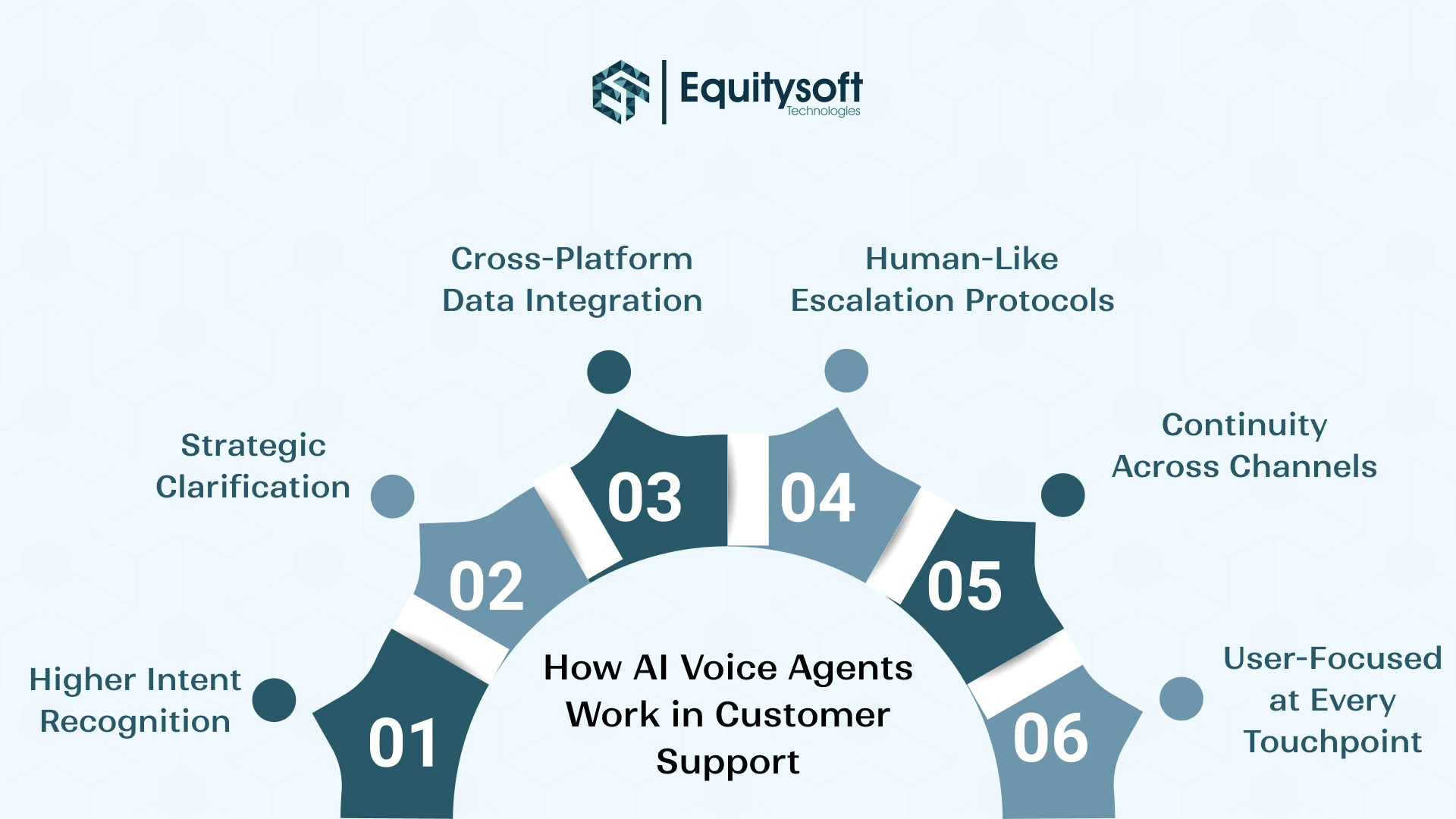
AI Voice Agents function as intelligent, automated support representatives capable of understanding natural speech, analyzing intent, and delivering human-like responses. Using advanced NLP, speech recognition, and decision-making algorithms, they manage complete support interactions from start to finish.
1. Higher Intent Recognition
When a customer speaks, the AI Voice Agent evaluates multiple layers of communication, including:
- intent
- linguistic patterns
- sentiment
- urgency
- context
Instead of relying on simple keyword detection, the system interprets what the customer actually means enabling accurate and meaningful responses.
2. Strategic Clarification
If more information is needed, the agent asks precise clarification questions to avoid confusion.
Example: “Do you want to cancel your order or update the delivery date?”
This reduces unnecessary back-and-forth and accelerates issue resolution.
3. Cross-Platform Data Integration
AI Voice Agents integrate seamlessly with backend systems such as:
- CRM platforms
- inventory databases
- ticketing systems
- payment gateways
- knowledge bases
This allows them to fetch real-time information and execute actions instantly.
4. Human-Like Escalation Protocols
When the system detects:
- emotional distress
- complex or multi-step issues
- sensitive account data
It automatically transfers the conversation to a human agent, passing along full conversation context. This ensures a smooth, frustration-free handoff.
5. Continuity Across Channels
AI Voice Agents maintain a unified conversation history across channels like:
- voice calls
- website chat
- mobile apps
Customers never need to repeat their concerns a major improvement over traditional support processes.
6. Personalization at Every Touchpoint
By leveraging past interactions, purchase history, and user preferences, the AI delivers:
- tailored responses
- relevant recommendations
- personalized solutions
This elevates customer satisfaction and strengthens long-term trust.
Core Features of AI Voice Agents for Customer Service
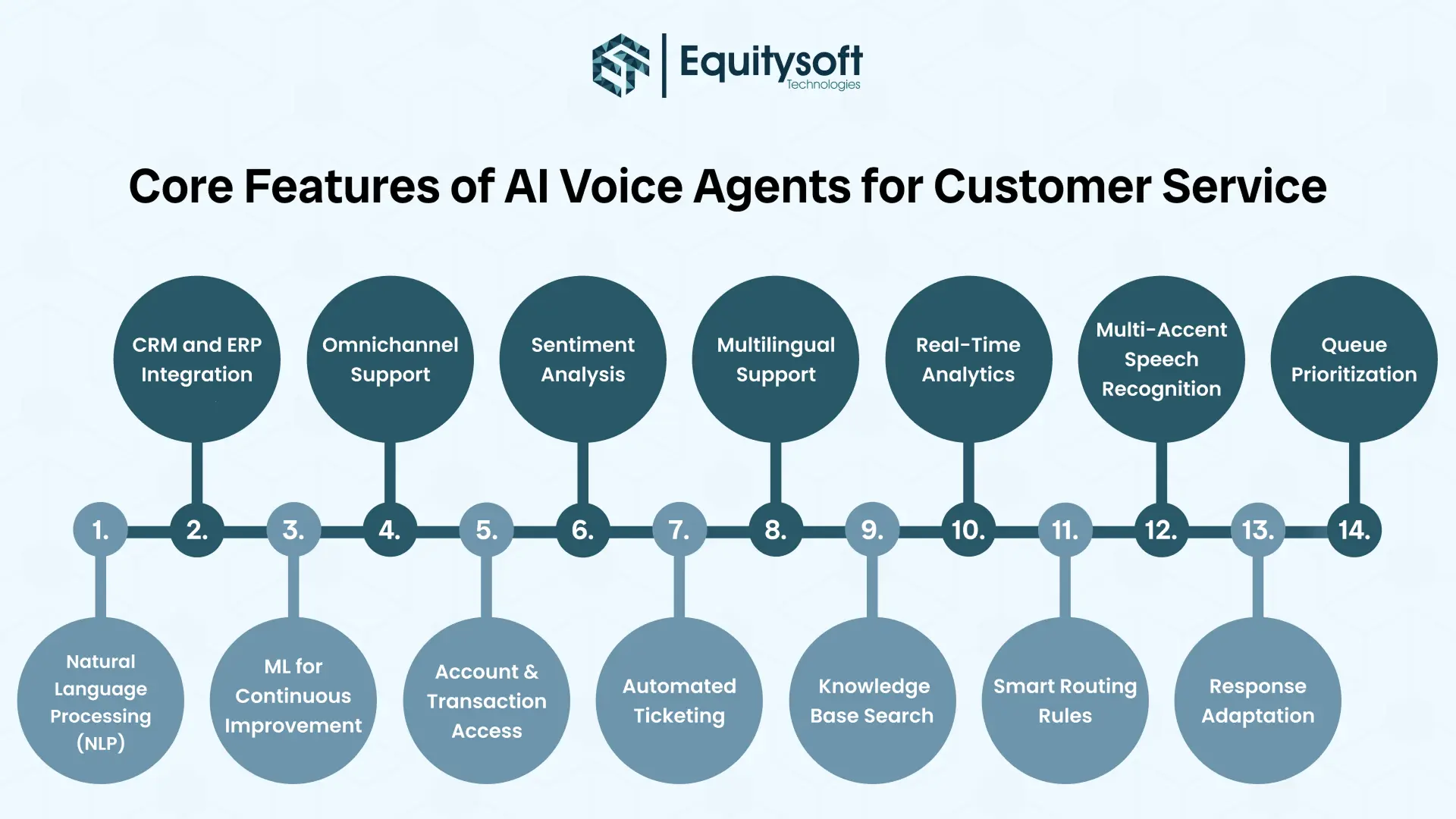
AI Voice Agents offer a powerful set of capabilities that go far beyond traditional IVR systems, enabling businesses to deliver faster, more accurate, and more personalized support experiences. Below are the key features that make them highly effective in modern customer service operations:
1. Natural Language Processing (NLP)
NLP enables AI Voice Agents to understand natural human speech, detect intent, interpret context, and respond conversationally. This allows customers to speak freely without following rigid command structures.
2. CRM and ERP Integration
Voice agents connect seamlessly with systems like CRM, ERP, and billing software, allowing them to fetch customer data, update records, and perform real-time actions such as checking order status or modifying account details.
3. Machine Learning for Continuous Improvement
With ML algorithms, AI Voice Agents learn from past interactions, improve accuracy, adapt to communication patterns, and refine their responses over time making them more efficient with every conversation.
4. Omnichannel Support
AI Voice Agents maintain consistent conversations across voice calls, chat, WhatsApp, mobile apps, and web platforms, giving customers a unified and uninterrupted support experience.
5. Account and Transaction Data Retrieval
Using secure data access protocols, voice agents can pull account details, verify identities, and retrieve order histories, payment information, or transaction updates instantly.
6. Sentiment Analysis
AI Voice Agents detect emotions such as frustration, urgency, or confusion. When negative sentiment is identified, they adjust their tone or escalate the issue to a human agent for better customer care.
7. Automated Ticketing
AI Voice Agents automatically create, assign, update, and close support tickets within service desk platforms reducing manual effort and speeding up issue resolution.
8. Multilingual Communication
AI Voice Agents support multiple languages and regional accents, enabling global customer reach and improving accessibility for diverse audiences.
9. Knowledge Base Search
By connecting to an organization’s knowledge base, AI can deliver accurate answers, troubleshooting steps, and FAQs within seconds without human involvement.
10. Real-Time Analytics
Businesses gain insights into call volume, resolution time, customer sentiment, escalation patterns, and performance trends, enabling continuous improvement of support operations.
11. Smart Routing Rules
Based on issue type, customer profile, or detected sentiment, the system routes calls to the right agents or departments ensuring faster and more effective handling.
12. Speech Recognition Across Accents
Advanced ASR (Automatic Speech Recognition) allows AI to understand diverse accents, speech speeds, and phrasing variations, reducing misunderstandings and enhancing accuracy.
13. Response Customization
AI Voice Agents adapt their tone, language style, and message format based on user preferences, profiles, and interaction history delivering highly personalized conversations.
14. Queue Prioritization
During peak hours, AI prioritizes issues based on urgency, customer type (e.g., VIP), or problem severity ensuring critical cases are handled quickly and efficiently.
Challenges of AI Customer Service (and Their Solutions)
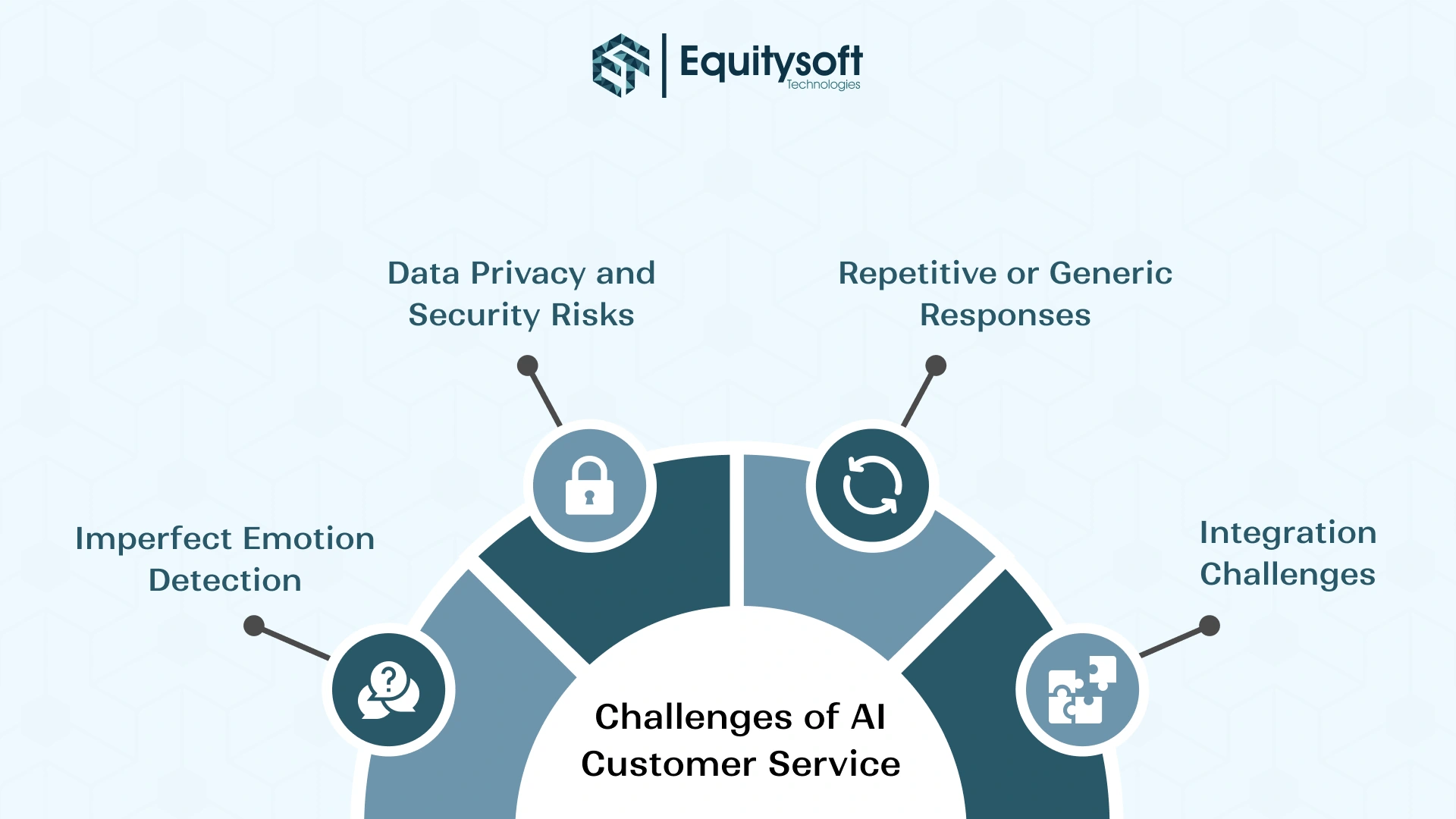
While AI-powered customer service offers powerful advantages, it also comes with certain limitations. Below are the major challenges businesses face along with practical, effective solutions for overcoming them.
1. Imperfect Emotion Detection
AI systems may struggle to accurately detect customer frustration, stress, or urgency, leading to inappropriate or delayed responses.
Solution: Implement hybrid escalation workflows, regularly retrain sentiment models, and fine-tune emotional detection algorithms to improve accuracy over time.
2. Data Privacy and Security Risks
Handling sensitive customer information always involves security risks, especially if systems are not configured properly.
Solution: Use end-to-end encryption, secure cloud storage, strict role-based access control, and maintain compliance with GDPR and industry-specific regulations.
3. Repetitive or Generic Responses
Customers tend to lose trust when interactions feel robotic or lack personalization.
Solution: Integrate AI with CRM systems, train models on contextual datasets, and use behavioral insights to deliver personalized, context-aware responses.
4. Integration Challenges
Connecting AI systems with older or fragmented software environments can be technically complex.
Solution: Work with experienced AI developers skilled in APIs, middleware, and system architecture to ensure smooth integration with legacy platforms.
Future Trends: Where AI Voice Agents Are Heading
AI Voice Agents are rapidly advancing and becoming central to next-generation customer experience. The upcoming trends shaping their evolution include:
- Emotion-Aware Conversations: Future voice agents will better understand tone, stress, and sentiment for more empathetic responses.
- Voice-First Customer Support: Voice automation will become a primary support channel.
- AI Copilots for Human Agents: Real-time assistance, suggestions, and automated insights during calls.
- Hyper-Personalization: Behavioral analytics will tailor customer interactions uniquely.
- Predictive Support: AI will foresee potential issues and reach out proactively.
- Autonomous Workflows: AI will handle end-to-end support tasks independently.
- Self-Learning Systems: Continuous learning will improve accuracy and natural communication.
Overall, AI Voice Agents are shifting from simple automation tools to intelligent, proactive partners in customer experience management.
Upgrade your customer support experience with AI voice agents.
Automate calls, reduce costs, and improve CSAT starting today.

Conclusion
AI Voice Agents are transforming customer service with intelligent automation, instant responses, and highly contextual conversations. As personalization and speed become non-negotiable, companies adopting AI Voice Agents for customer support will stay ahead in customer satisfaction and operational efficiency.
With expert partners like Equitysoft Technologies, businesses can build reliable, scalable, and multilingual voice agent systems that deliver outstanding customer experiences today and in the future.
Frequently Asked Questions
Get answers to common questions about AI in eCommerce