AI integration is no longer limited to large enterprises or tech-focused companies. Today, AI integration development has become a practical solution for businesses facing everyday operational challenges such as repetitive manual work, delayed processes, rising operational costs, and difficulty scaling operations efficiently.
Daily tasks like handling customer queries, managing emails, updating records, approving invoices, and generating reports consume valuable time and reduce productivity. Through AI integration, businesses can automate these routine activities, reduce human errors, and improve efficiency across departments.
AI-powered systems handle customer support, data processing, forecasting, and reporting seamlessly, allowing teams to focus on strategic and revenue-generating activities. In short, AI integration helps businesses save time, streamline operations, and make smarter, data-driven decisions while supporting sustainable growth.
Introduction to AI Integration in Business
Every business small or large faces the challenge of managing repetitive, time-consuming tasks daily. Activities such as responding to emails, entering data, tracking inventory, scheduling meetings, and approving invoices take up valuable human hours that could be invested in innovation, strategy, and growth.
AI integration development bridges this gap by automating routine operations with speed, accuracy, and scalability. By reducing manual effort, AI enables teams to operate more efficiently while maintaining consistency across workflows.
Businesses adopting AI integration report faster task execution, lower operational costs, improved customer experiences, and reliable data-driven decision-making. Importantly, AI is not replacing humans, it is augmenting human potential by freeing teams to focus on high-impact work.
What Is AI Integration?
AI integration refers to embedding artificial intelligence technologies into existing business systems, workflows, and applications to automate operations and enhance decision-making.
It involves connecting AI models with platforms such as:
- CRM systems
- ERP software
- Websites and mobile applications
- Marketing automation tools
- Customer support platforms
With AI integration, systems can learn from data, identify patterns, predict outcomes, and make intelligent decisions in real time. Unlike traditional rule-based automation, AI-driven automation continuously improves over time making businesses more agile and future-ready.
Why Businesses Are Moving Toward Automation
Businesses today are under constant pressure to:
- Do more with fewer resources
- Deliver faster customer responses
- Reduce manual errors
- Scale operations without increasing costs
AI-powered automation solves these challenges by:
- Eliminating repetitive manual work
- Operating 24/7 without fatigue
- Improving accuracy and consistency
- Adapting to changing business needs
Organizations that adopt AI integration development gain a strong competitive advantage through improved efficiency, scalability, and customer satisfaction.
Key Business Areas Where AI Automates Daily Tasks
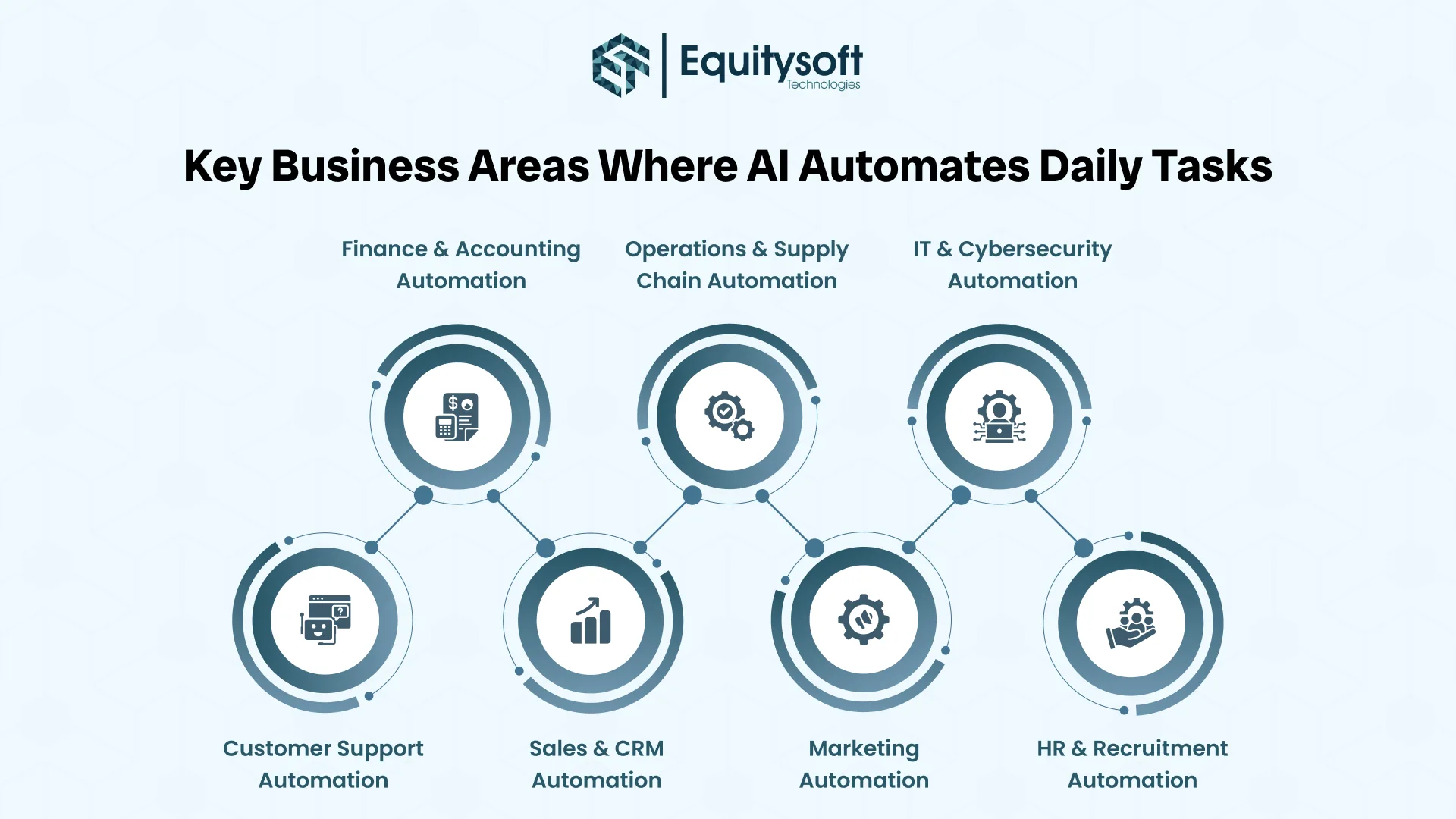
Customer Support Automation
AI integration for customer support enables businesses to manage high query volumes while meeting expectations for instant responses.
How AI helps:
- AI chatbots handle FAQs instantly
- Virtual assistants resolve common issues
- Automated ticket routing prioritizes urgent queries
- Sentiment analysis detects unhappy customers
Businesses using AI chatbots significantly reduce support costs while improving response speed and consistency.
Sales & CRM Automation
AI integration allows sales teams to focus on closing deals rather than managing data.
Daily tasks automated:
- Lead scoring and qualification
- Sales forecasting
- Follow-up reminders
- Customer behavior analysis
AI-powered CRMs analyze historical data to predict high-conversion leads, improving productivity and revenue outcomes.
Marketing Automation
Marketing teams use AI integration development to automate and optimize campaigns.
AI automates:
- Email personalization
- Ad targeting and optimization
- Content recommendations
- Social media scheduling
AI-driven marketing ensures the right message reaches the right audience at the right time, increasing engagement and ROI.
HR & Recruitment Automation
HR teams benefit from AI integration by reducing manual workload and improving hiring quality.
AI helps by:
- Screening resumes automatically
- Matching candidates to job requirements
- Automating interview scheduling
- Predicting employee retention risks
This results in faster hiring cycles and better talent acquisition.
Finance & Accounting Automation
Finance teams rely on AI integration development for accuracy and compliance.
AI automates:
- Invoice processing
- Expense categorization
- Fraud detection
- Cash flow forecasting
AI-driven financial systems reduce errors and provide real-time insights for better financial control.
Operations & Supply Chain Automation
AI integration improves operational efficiency and reduces wastage.
Automated tasks include:
- Demand forecasting
- Inventory optimization
- Route planning
- Vendor performance analysis
Businesses avoid overstocking, lower logistics costs, and improve delivery timelines.
IT & Cybersecurity Automation
AI integration strengthens IT infrastructure and security by:
- Detecting system anomalies
- Preventing cyber threats
- Automating system monitoring
- Predicting infrastructure failures
AI-powered security systems continuously learn from new threats, ensuring proactive protection.
Industry-Wise AI Automation Use Cases
Healthcare
- Appointment scheduling automation
- Medical data analysis
- Patient support chatbots
Impact: Reduced administrative workload, improved patient experience, and better clinical decisions.
E-commerce
- Personalized product recommendations
- Dynamic pricing
- Order tracking automation
Impact: Higher conversions and customer retention.
Finance
- Risk assessment
- Credit scoring
- Fraud detection
Impact: Improved security, faster approvals, and compliance.
Manufacturing
- Predictive maintenance
- Quality control
- Production optimization
Impact: Reduced downtime, lower costs, and improved product quality.
Benefits of AI Integration for Daily Business Tasks
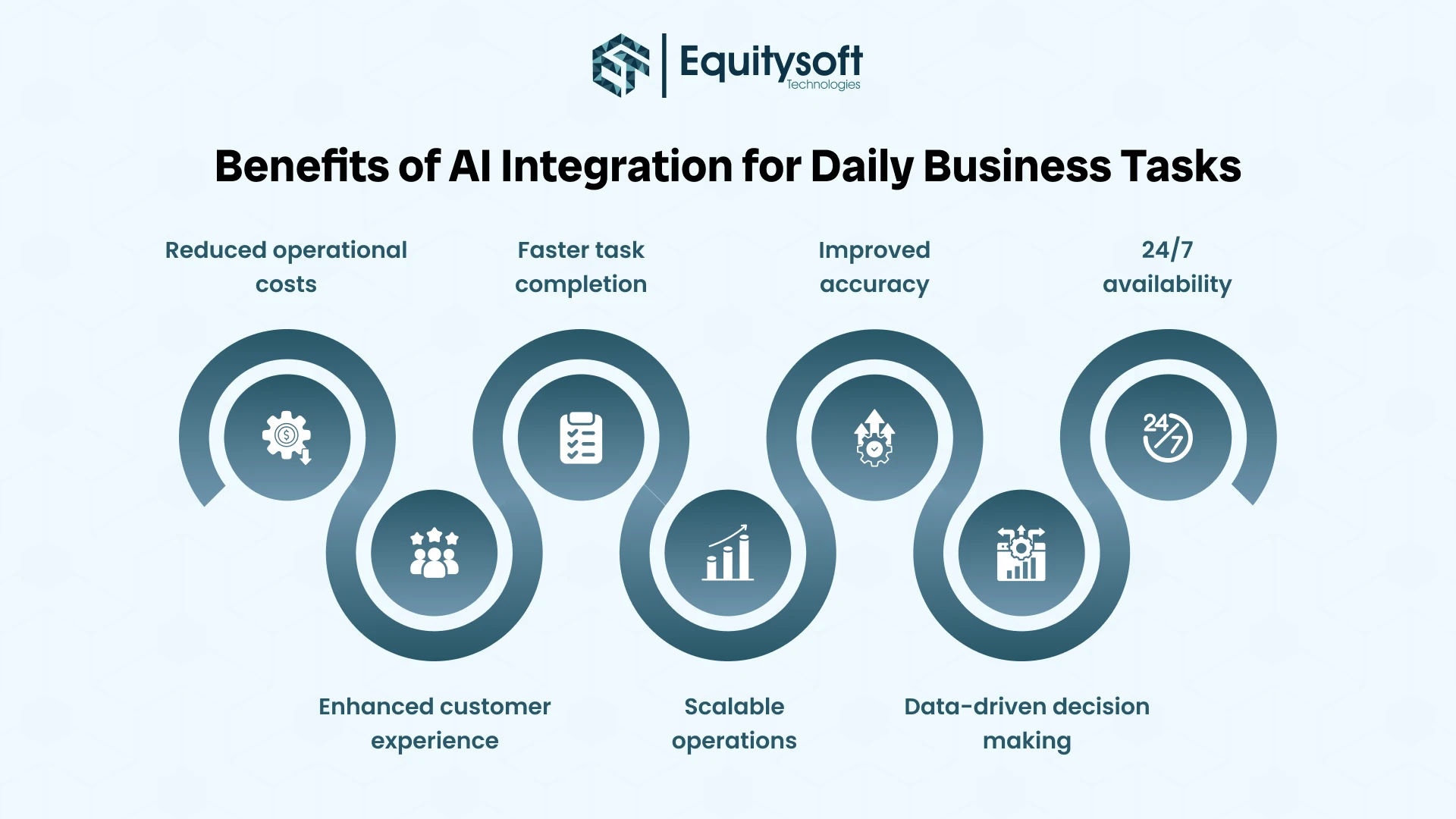
- Reduced operational costs through automation
- Faster task completion with real-time processing
- Improved accuracy and fewer errors
- 24/7 availability without downtime
- Enhanced customer experience through personalization
- Data-driven decision-making
- Scalable operations without proportional cost increase
AI integration enables businesses to shift from reactive workflows to proactive strategies.
Challenges in AI Integration (and How to Overcome Them)
Common challenges:
- Data quality issues
- Legacy system integration
- High initial investment
- Employee resistance
Solutions:
- Start with pilot projects
- Clean and structure data
- Choose scalable AI tools
- Train teams effectively
- Work with experienced AI consultants
A strategic approach ensures long-term success.
AI Integration Tools & Technologies
Key technologies powering AI integration development:
- Machine Learning (ML)
- Natural Language Processing (NLP)
- Computer Vision
- Predictive Analytics
- Robotic Process Automation (RPA)
Businesses often integrate AI with enterprise platforms from Google and Microsoft to enhance existing systems.
Steps to Successfully Integrate AI into Your Business
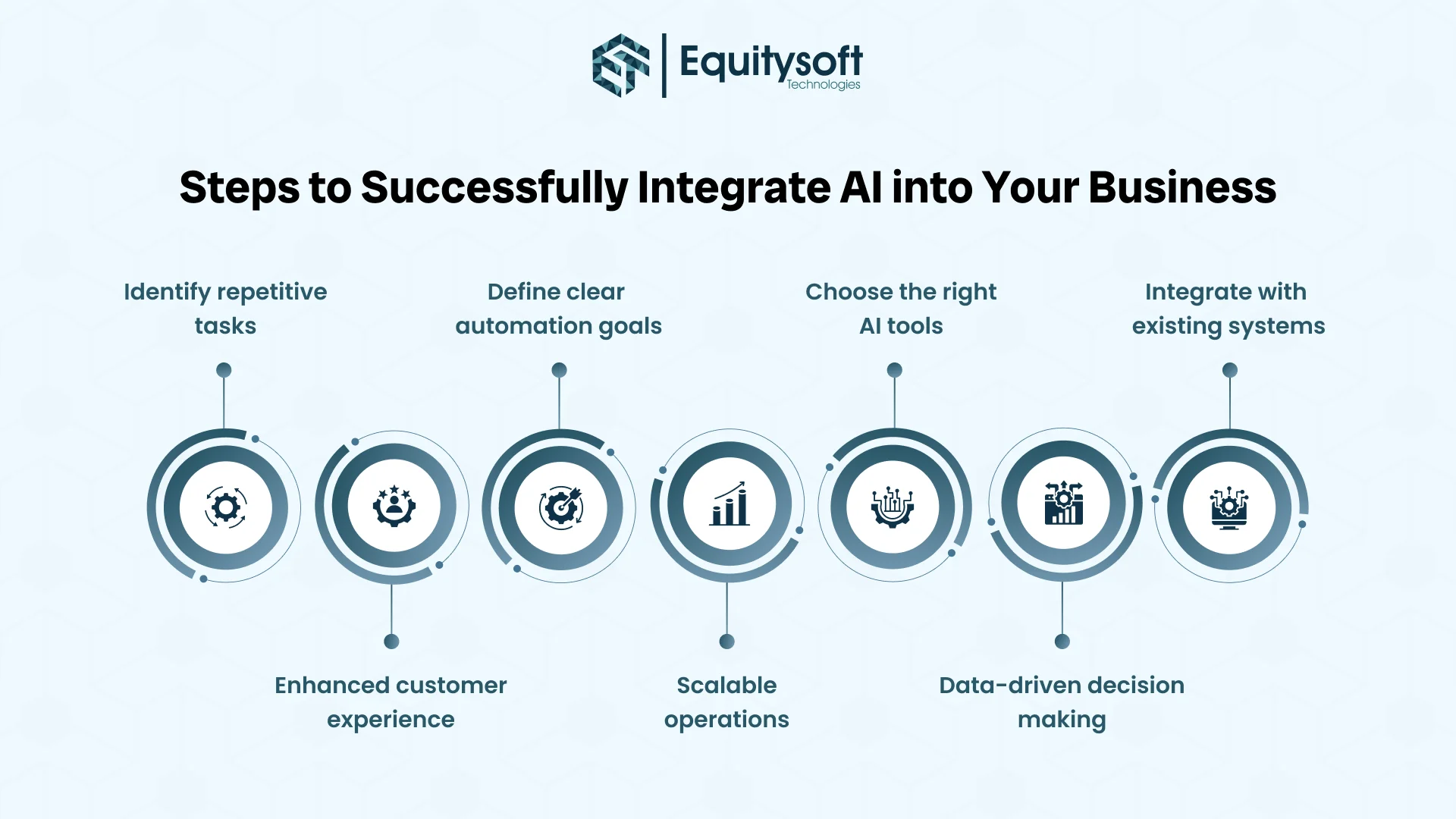
- Identify repetitive tasks
- Define clear automation goals
- Choose the right AI tools
- Integrate with existing systems
- Train employees
- Monitor performance
- Scale gradually
AI integration is a continuous journey not a one-time project.
AI Integration for Small vs Large Businesses
AI Integration for Small Businesses
AI integration for small business focuses on:
- Automating customer support
- Using AI chatbots
- Implementing AI-powered marketing tools
This helps SMEs compete efficiently without increasing headcount.
AI Integration for Large Enterprises
Large organizations use:
- End-to-end process automation
- Advanced analytics
- Custom AI models
AI enables enterprise-scale efficiency and innovation.
Future of AI-Driven Business Automation
- Autonomous business workflows
- Hyper-personalized customer experiences
- Predictive decision engines
- Voice-based business assistants
AI will evolve from a support tool into a strategic business partner.
Final Thoughts: Why AI Integration Is No Longer Optional
AI integration is no longer just about efficiency; it is critical for business survival and growth. Companies that automate daily business tasks with AI respond faster, operate smarter, and scale effortlessly.
Whether you are a startup or an enterprise, investing in AI integration development today prepares your business for tomorrow. With expert guidance from Equitysoft Technologies, businesses can adopt AI confidently and turn automation into a long-term competitive advantage.