Artificial Intelligence has evolved from a futuristic concept into a practical engine that drives business growth. Today, companies rely on AI systems to deliver fast customer service, streamline internal operations, and provide personalized digital experiences. Employees expect intelligent tools that reduce manual workloads, while decision-makers look for automation systems that are scalable, accurate, and efficient.
However, with the rapid increase in AI adoption, many businesses face confusion when choosing between AI chatbots and AI agents. Although these technologies appear similar, the underlying intelligence, autonomy, and execution power vary dramatically. Treating them as the same often leads to weak automation, poor user experience, and missed operational opportunities.
This in-depth article clarifies the real differences between the two. It explains What is an AI chatbot, What is an AI agent, how they work, their limitations, where they fit best, and how modern AGENTIC AI is reshaping business automation. If you’re exploring AI chatbot development or AI agent development, this guide will help you choose the right approach.
What Is an AI Chatbot?
An AI chatbot is a conversational tool that interacts with users through text or voice. It simulates human-like conversations to answer questions and guide users. Most chatbots work on predefined rules and respond reactively to predictable queries.
How AI Chatbots Work
Chatbots process user messages using intent detection and entity recognition. They match queries with predefined responses from a knowledge base. Even with NLP, their logic is structured and limited to programmed scenarios.
What Chatbots Can Do
Chatbots handle FAQs, guide users, and collect basic information. They support lead generation by asking qualifying questions. They also manage simple tasks like booking, troubleshooting, and greeting website visitors.
What Chatbots Cannot Do
Chatbots cannot manage complex workflows or multi-step processes. They lack reasoning, deep personalization, and long-term memory. Without integrations, they cannot update internal systems or make independent decisions.
Ideal Use Cases for AI Chatbots
Chatbots fit industries with repetitive, high-volume queries. E-commerce, healthcare, education, hospitality, and SaaS use them for quick support. They work best where conversations are predictable and simple.
What Exactly Is an AI Agent?
An AI agent is an advanced system that can reason, plan, and take autonomous actions not just respond to messages. It works like a digital employee capable of completing end-to-end tasks. Agents analyze input, execute multi-step operations, and adapt based on results, making them ideal for complex workflow automation.
How AI Agents Work
AI agents follow a perception-action cycle: understand the input, plan the steps, and execute tasks autonomously. They choose which tools, APIs, or databases to interact with for fulfillment. After execution, they evaluate the outcome to improve future performance.
What AI Agents Can Do
Agents perform multi-step reasoning tasks like updating records, modifying orders, or generating reports. They handle complex support cases by pulling data from internal systems. They can automate sales, operations, HR, and analytics workflows by connecting with various tools.
What AI Agents Cannot Do Yet
AI agents cannot replace human roles requiring emotion, judgment, or ethical decision-making. They struggle with vague instructions and need structured workflows and clear permissions. They also rely heavily on integrated systems and cannot perform real-world physical tasks.
Ideal Use Cases for AI Agents
Agents shine in environments where tasks are repetitive but require intelligence. They automate refunds, lead scoring, CRM updates, onboarding tasks, inventory control, and IT troubleshooting. Industries like SaaS, finance, logistics, healthcare, and e-commerce gain major efficiency from agent-driven automation.
| AI Chatbots | AI Agents | |
|---|---|---|
| Primary Purpose | Handle conversations, answer FAQs, and guide users. | Think, plan, and execute tasks independently. |
| Intelligence Level | Low – rule-based, predictable interactions. | High – contextual understanding and reasoning. |
| Memory | Short-term memory; resets after sessions. | Long-term memory; learns from past interactions. |
| Task Execution | Cannot perform complex or multi-step tasks. | Performs multi-step workflows autonomously. |
| Autonomy | Very limited; follows scripted flows. | Highly autonomous; chooses best methods to complete tasks. |
| Adaptability | Struggles with vague or changing requirements. | Adapts to dynamic situations and unclear instructions. |
| Business Impact | Improves communication and provides basic support. | Transforms operations with intelligent workflow automation. |
Benefits of AI Chatbots
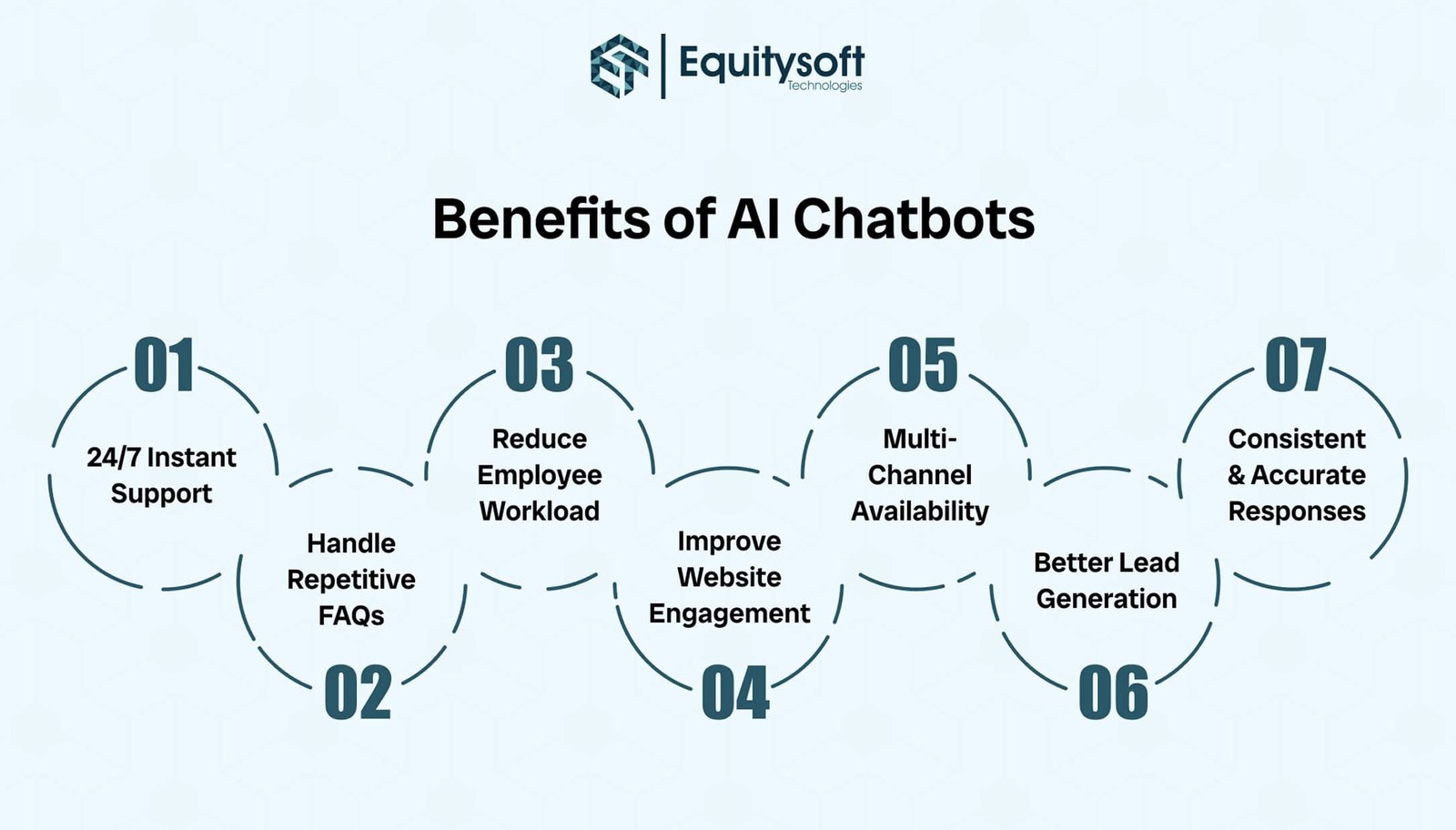
- 24/7 Instant Support: Chatbots provide round-the-clock responses, ensuring customers get immediate help without waiting for business hours.
- Handle Repetitive FAQs: They efficiently answer common questions like order status or appointment details, reducing the load on human teams.
- Reduce Employee Workload: By managing routine interactions, chatbots free staff to focus on complex tasks that require human decision-making.
- Improve Website Engagement: Chatbots guide users through products, services, and conversions, making the customer journey smoother and faster.
- Multi-Channel Availability: They work across websites, mobile apps, WhatsApp, Instagram, and more, creating a unified communication experience.
- Better Lead Generation: Chatbots collect user details instantly, qualify leads, and send them to sales teams, increasing conversion opportunities.
- Consistent and Accurate Responses: They deliver uniform answers every time, maintaining brand tone and reducing communication errors.
Limitations of AI Chatbots
- Limited Intelligence for Complex Queries: Chatbots struggle with ambiguous or multi-layered questions because they rely on predefined rules.
- No Autonomous Task Execution: They cannot update systems or complete actions independently, functioning mostly as response-based tools.
- Weak Handling of Complex Support Issues: When a query needs data analysis or system updates, chatbots often fail and escalate the issue to human agents.
- Restricted Tool and System Access: Their integration abilities are basic, making them ineffective for advanced workflows or internal operations.
- Lack of Long-Term Memory: Chatbots treat every conversation as new, preventing deep personalization or continuity in user experiences.
- Frequent Manual Updates Needed: Every new scenario requires re-training or adding new flows, limiting long-term scalability and flexibility.
Benefits of AI Agents
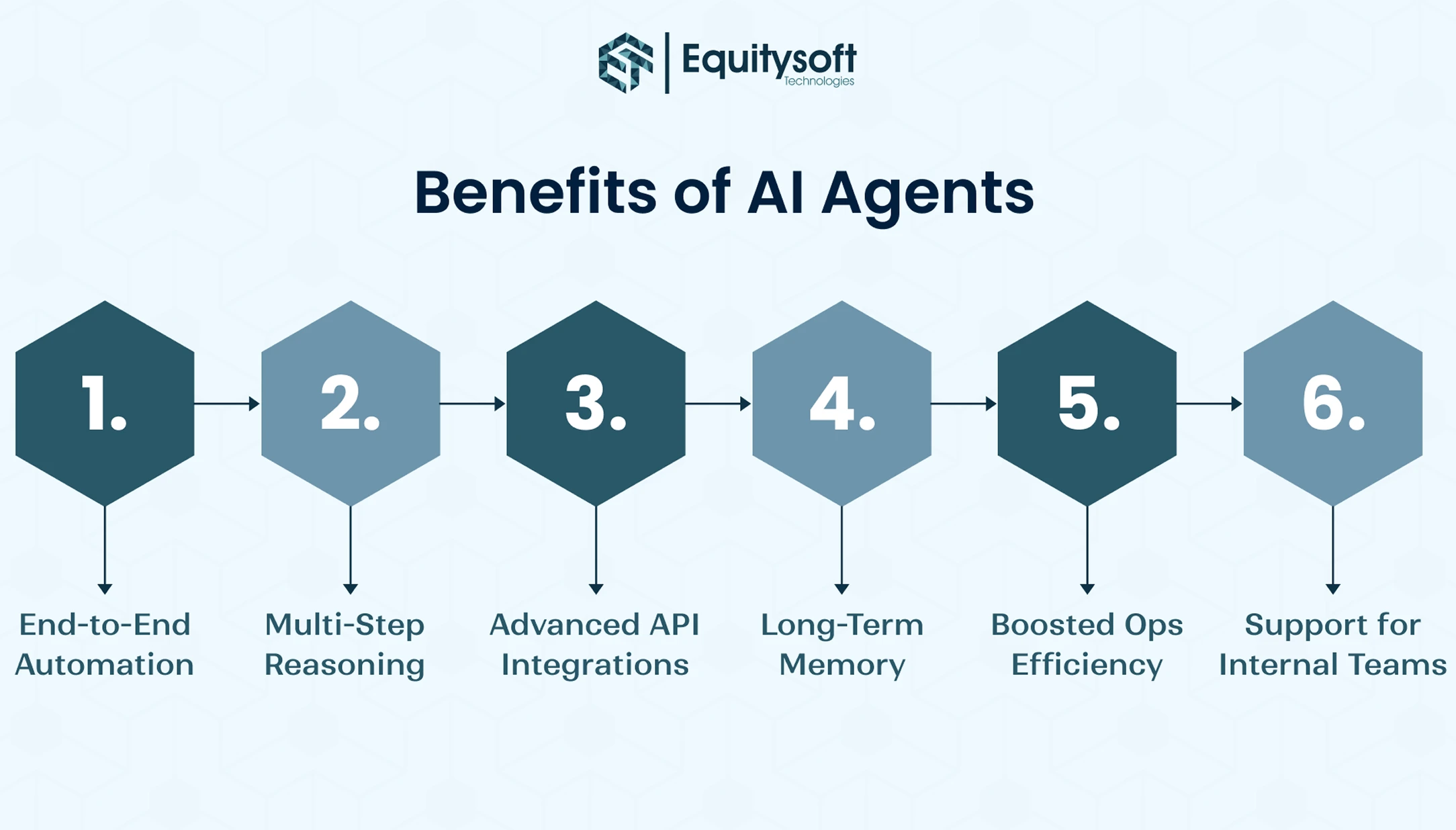
- End-to-End Automation: AI agents complete tasks independently from checking data to updating systems reducing manual work and improving customer experience.
- Multi-Step Reasoning: They break complex tasks into smaller actions and execute them in sequence, making them ideal for industries with layered processes.
- Deep Tool & API Integrations: Agents connect with CRMs, ERPs, databases, ticketing tools, and email systems to automate operations across business platforms.
- Long-Term Memory: They retain past interactions and context, enabling personalized responses and continuity for returning customers.
- Increased Operational Efficiency: Agents perform tasks in seconds, eliminating delays and preventing workflow bottlenecks across busy departments.
- Support for Internal Teams: They act as digital assistants for HR, IT, sales, and operations, helping with onboarding, troubleshooting, scheduling, and reporting.
Limitations of AI Agents
- Higher Setup & Integration Effort: Because they interact deeply with internal systems, agents require proper configuration, secure access, and structured implementation.
- Dependence on Clean Data: Agents work best when information is accurate and organized; poor data quality can reduce task accuracy and reliability.
- Strict Security Requirements: They need controlled permissions and governance to protect sensitive data and prevent unauthorized system actions.
- Continuous Monitoring Needed: Even though they learn over time, agents require supervision to ensure tasks are executed correctly and aligned with business rules.
- Struggles with Ambiguous Instructions: When users give unclear or conflicting commands, agents may misinterpret actions and require human intervention.
- Cannot Replace Human Judgment: Tasks involving emotion, negotiation, ethics, or subjective decision-making still depend on humans, not AI agents.
Not sure which AI solution fits your business?
Let our AI specialists analyze your workflow and recommend the perfect chatbot or AI agent solution.
Real-World Examples of Chatbots vs. AI Agents
Real Chatbot Examples
- E-commerce Support: Chatbots answer repeated questions about deliveries, returns, product availability, and tracking.
- Hospitality & Restaurants: Manage reservations, menu inquiries, and room availability, reducing call volumes.
- Healthcare Clinics: Book appointments, provide service info, and guide patients with preparation steps.
- Education & Admissions: Answer admission queries, explain programs, and guide students through course options.
- SaaS Onboarding: Assist new users with onboarding and troubleshooting.
- Customer Support (Basic Issues): Reset passwords, provide links, and help users find pages.
- Real Estate Inquiries: Answer property-related questions like pricing and availability.
- WhatsApp & Instagram Automation: Greet users, share catalogs, and manage simple flows.
Real AI Agent Examples
- Automated Refund Processing: Verify data, check eligibility, initiate refunds, and update systems autonomously.
- Lead Qualification & Sales Automation: Score leads, update CRMs, and schedule follow-ups.
- Logistics & Supply Chain Optimization: Assign routes, update tracking, and coordinate deliveries.
- HR Onboarding Automation: Collect documents, schedule orientations, and guide new hires.
- Finance & Reporting Tasks: Generate reports, analyze expenses, and verify approvals.
- IT Support & Troubleshooting: Diagnose system issues and resolve tickets automatically.
- Marketing Optimization: Adjust budgets, review campaigns, and suggest improvements.
- Healthcare Coordination: Manage appointments, reminders, and patient records efficiently.
Decision-Making Framework: Chatbot or AI Agent?
- Choose a Chatbot for Simple Communication: Ideal for FAQs, guidance, and basic troubleshooting.
- Choose a Chatbot for Lightweight Automation: Best for quick responses without deep integrations.
- Choose an AI Agent for Advanced Automation: Handles multi-step workflows and decision-making.
- Choose an AI Agent for System-Level Work: Perfect for CRM, ERP, and internal updates.
- Choose an AI Agent for Personalization: Uses memory and context for tailored user experiences.
- Final Choice: If you only need communication, a chatbot is enough. If you need automation and execution, go with an AI agent.
Future Trends: What’s Coming Next for AI Chatbots and AI Agents
- Fully Autonomous AI-Driven Business Units: Agents will plan, execute, and coordinate tasks independently.
- Multi-Agent Collaboration Systems: Specialized agents (sales, support, finance) will communicate and work together.
- Rise of Voice-First AI Interfaces: Voice agents will simplify support and operations through natural conversation.
- Predictive & Proactive Decision-Making: Agents will act before users ask, preventing issues and optimizing workflows.
- Industry-Specific AI Agents: Custom agents will handle domain-specific tasks in healthcare, finance, logistics, and retail.
- Deeply Personalized Customer Journeys: Agents will adapt interactions based on user history and preferences.
- Unified Business System Orchestration: Agents will connect CRMs, ERPs, and communication tools for seamless workflows.
Conclusion: Which Is Right for Your Business?
Choosing between an AI chatbot and an AI agent depends on how deeply your business wants to automate its operations. If your main goal is to improve customer communication, answer FAQs, collect leads, or offer quick support, an AI chatbot is the perfect fit simple, cost-effective, and ideal for predictable interactions.
However, if your business needs advanced automation, intelligent decision-making, multi-step workflow execution, or deep integration with internal tools, an AI agent provides far greater value. AI agents work like digital employees, completing end-to-end tasks, reducing manual workload, and scaling operations across departments.
At Equitysoft Technologies, we help businesses combine both solutions effectively using chatbots to manage conversations and AI agents to power complex workflows in the background. This integrated approach creates a strong AI ecosystem that boosts efficiency, improves customer experience, and prepares companies for the next generation of digital automation.
As AI continues to advance, organizations that adopt AI agents early will gain a significant competitive advantage in speed, precision, and operational intelligence.
Frequently Asked Questions
Get answers to common questions about AI in eCommerce