
Artificial Intelligence (AI) has become one of the most transformative business technologies of the modern era. Once reserved for large enterprises with massive research budgets, AI tools are now accessible to businesses of all sizes, especially through AI Agents. For small and mid-sized businesses (SMBs), AI agents represent a powerful opportunity to automate operations, enhance productivity, improve customer service, boost sales performance, and scale faster without significantly increasing costs.
An AI agent is a digital worker, a software-based system designed to execute tasks autonomously. It understands user requests, analyzes data, makes decisions, and performs actions without continuous human supervision. Unlike traditional automation systems that rely solely on static rule-based programming, AI agents possess decision-making and learning abilities. They continuously optimize their behavior based on outcomes and changing business conditions.
For SMBs navigating challenges like limited staffing, rising customer expectations, intense market competition, and operational inefficiencies, AI agents are becoming indispensable. They enable companies to perform the work of much larger teams, ensuring consistent delivery of services at high levels of precision and speed, all with reduced overhead costs.
This blog explores how AI agents function, the types of agents available, and the specific business use cases that deliver the greatest return for small and mid-sized organizations.
Overview of AI Agents
An AI Agent is a smart software assistant designed to work independently to help your business achieve specific goals. It can understand information, analyze data, make decisions, and complete tasks automatically, just like a digital team member working 24/7.
AI agents operate across multiple business platforms, including:
- Your website and live chat tools
- CRM systems like customer support or sales dashboards
- ERP platforms for operations and reporting
- Email marketing and customer follow-ups
- Call center and voice assistant systems
- Internal business apps and collaboration tools
Instead of requiring human input for every action, AI agents observe what is happening inside these systems, determine the best next step, and execute tasks automatically. This helps businesses reduce manual work, respond more quickly to customers, and make more informed decisions based on real-time data.
Importance of AI for Small & Mid-Sized Businesses
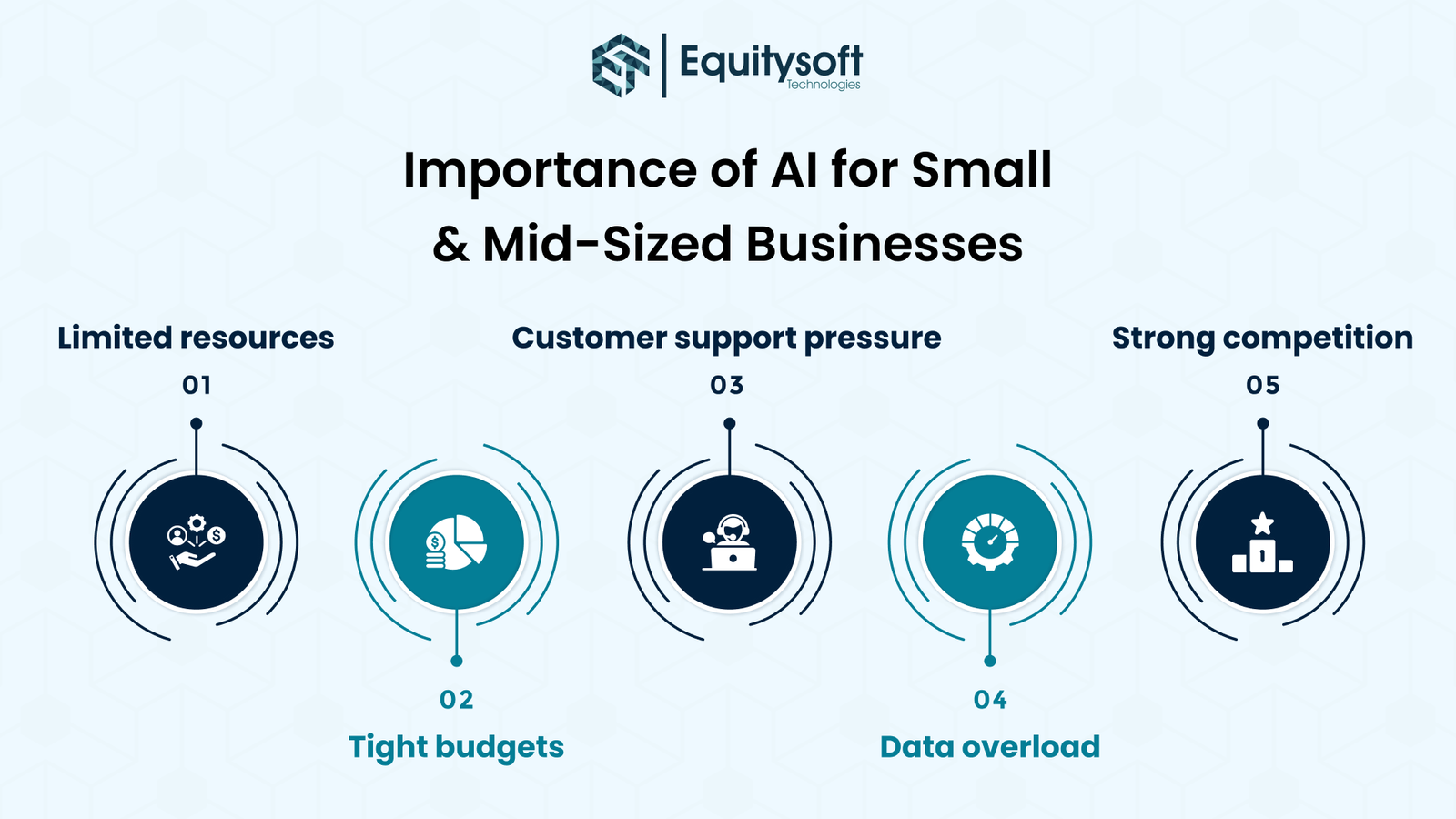
Small and mid-sized businesses (SMBs) account for over 90% of businesses worldwide and play a crucial role in creating jobs and driving local economies. Despite their importance, most SMBs operate with limited resources and face daily challenges when competing against large enterprises that have bigger teams, larger budgets, and advanced technology tools.
Common challenges faced by SMBs include:
- Limited resources: Small teams often juggle multiple roles, leading to burnout and reduced efficiency.
- Tight budgets: High-cost business tools and enterprise automation solutions may not be affordable for growing companies.
- Customer support pressure: Today’s customers expect instant answers, 24/7 availability, and personalized service.
- Data overload: Marketing, sales, and customer data pile up quickly, making it difficult to analyze trends or make data-backed decisions.
- Strong competition: SMBs must compete with large brands that already have optimized workflows and advanced support systems.
What Are AI Agents?
AI agents are virtual digital workers that perform business tasks automatically and independently. They operate 24/7, understand your business rules, analyze data, make decisions, and execute workflows to achieve specific goals just like a smart assistant for your operations.
Key capabilities of AI agents include:
- Perception: Collect data from chats, emails, forms, and systems
- Reasoning: Understand patterns and business context
- Decision-making: Choose the best next action
- Execution: Send emails, update records, schedule meetings, and trigger workflows
- Learning: Improve performance continuously over time
AI agents can replace manual tasks such as customer support replies, lead qualification, sales follow-ups, invoice preparation, appointment booking, and performance tracking-saving time, reducing costs, and improving business efficiency.
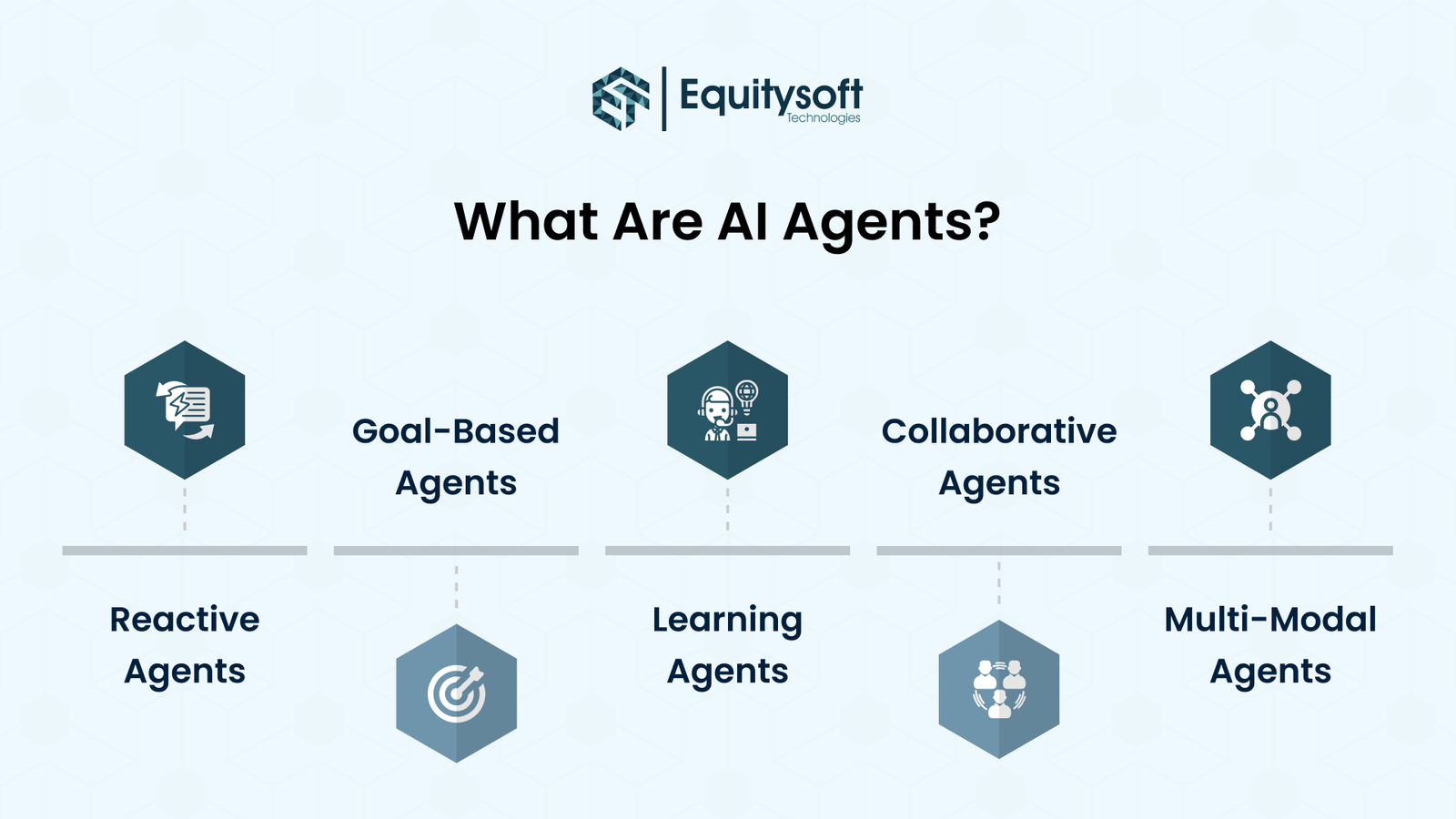
1. Reactive Agents
Reactive AI agents are the simplest form of AI automation. They provide pre-trained, rule-based responses without memory or continuous learning capabilities. These agents do not store conversation history or adapt their behavior based on past interactions. Instead, they respond to customer inputs using predefined scripts, keywords, or rules.
Common use cases:
- FAQ chatbots on websites
- Basic customer support auto-responders
- Help desk query routing
- Simple greeting or navigation bots
How they help businesses:
Reactive agents are quick to implement and low-cost, making them ideal for handling high-volume, repetitive questions such as pricing inquiries, working hours, or refund policies. They reduce the workload on support teams and offer instant replies to customers, ensuring faster response times without the need for human involvement.
2. Goal-Based Agents
Goal-based AI agents are designed to achieve specific business objectives rather than simply respond to questions. These agents analyze multiple possible actions and select the best option to reach a defined goal, such as increasing sales conversions, booking appointments, or qualifying leads.
Common use cases:
- Sales chatbots that guide users toward purchases
- Lead qualification tools that score inquiries
- Appointment booking assistants
- Onboarding workflow automation
How they help businesses:
Goal-based agents actively move customers through the sales or engagement funnel. For example, they can determine when to offer discounts, request contact details, or schedule demos. This intelligent decision-making allows businesses to increase conversion rates and improve workflow efficiency while minimizing manual sales follow-ups.
3. Learning Agents
Learning AI agents continuously improve performance by studying past interactions, customer behavior, and real-world outcomes. Using machine learning techniques, these agents refine responses, optimize recommendations, and personalize engagement over time.
Common use cases:
- Personalized product or service recommendations
- Adaptive customer support systems
- Marketing automation and targeting tools
- Predictive customer behavior analysis
How they help businesses:
Learning agents ensure that customer interactions become smarter with every conversation. They adapt to preferences, identify common problems more quickly, and improve accuracy, helping businesses deliver more personalized experiences while boosting customer satisfaction and support efficiency.
4. Collaborative Agents
Collaborative AI agents work alongside human teams or other AI agents, acting as digital assistants rather than independent operators. Instead of replacing staff, they support decision-making, speed up workflows, and enhance productivity across departments.
Common use cases:
- HR recruitment screening and resume analysis
- Marketing campaign planning and performance tracking
- Sales enablement tools that suggest follow-up actions
- Project management and operational coordination
How they help businesses:
Collaborative agents eliminate repetitive administrative tasks and provide real-time decision support, enabling staff to focus on creative strategy and relationship-building. They improve team efficiency while maintaining a strong human-AI partnership model.
5. Multi-Modal Agents
Multi-modal AI agents can interact across multiple communication channels and data formats, including text, voice, form inputs, and visual recognition. These agents are particularly valuable when businesses require seamless customer engagement across platforms.
Common use cases:
- Customer service call centers with voice bots
- Sales chatbots integrated with video calls or document scanning
- Complaint processing systems using image uploads
- Identity verification and document review workflows
How they help businesses:
By handling multiple interaction types, multi-modal agents create a unified customer experience across channels. They improve accessibility, deliver faster problem resolution, and automate complex workflows that require both audio, text, and visual data inputs.
Top 10 AI Agent Use Cases for Small & Mid-Sized Businesses
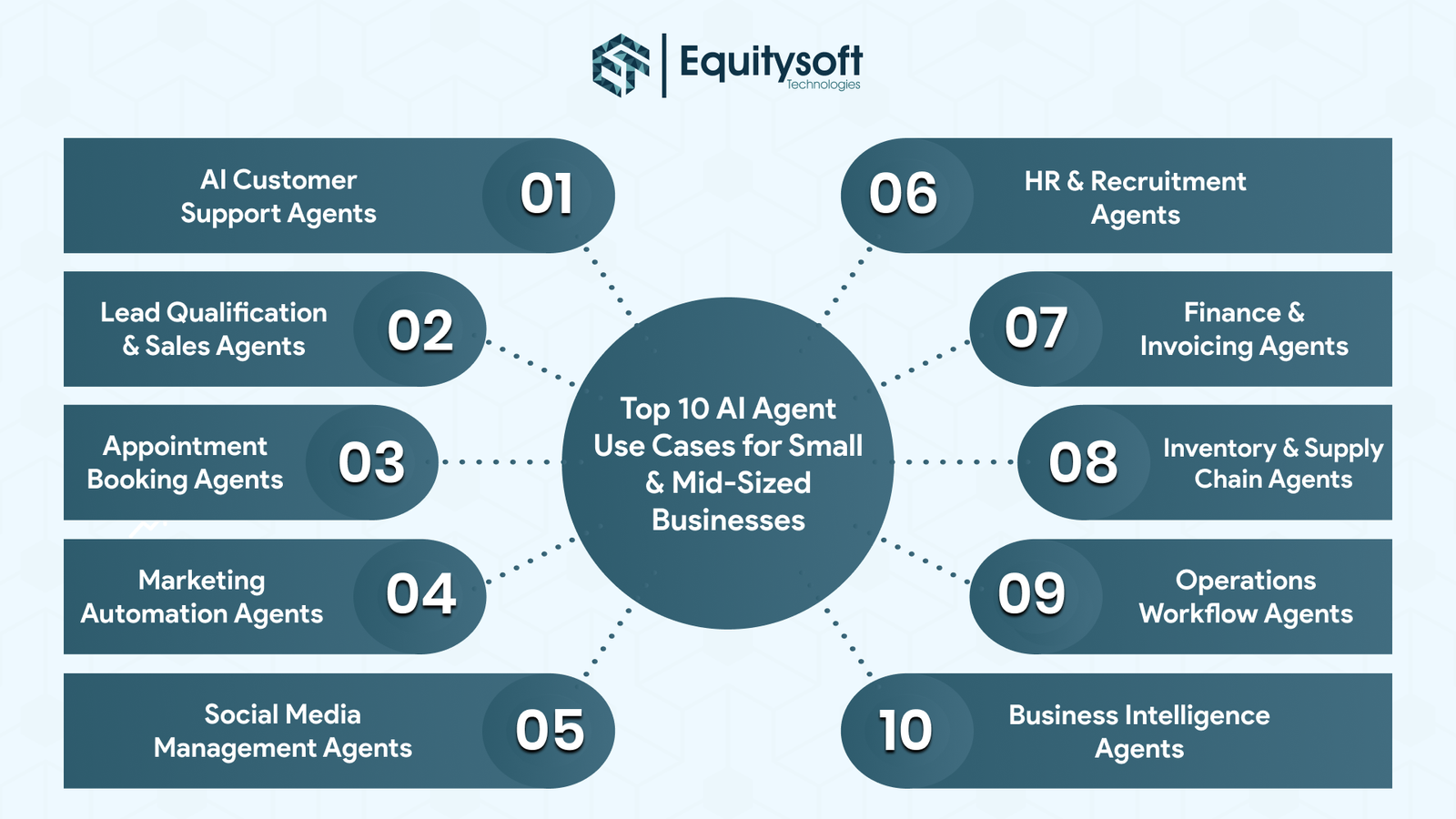
1. AI Customer Support Agents
AI customer support agents manage everyday service tasks such as answering FAQs, tracking orders, confirming appointments, resolving basic (tier-1) issues, and routing complaints to the right department. These agents work 24/7 across chat, email, and voice channels, automating over 60% of support volume for many businesses. The result is faster issue resolution, better customer satisfaction scores, and significantly reduced support team costs.
2. Lead Qualification & Sales Agents
Sales AI agents instantly engage new leads from websites, ads, and social platforms. They ask qualification questions, score prospects based on buying intent, schedule sales calls or demos, and update CRM records automatically. This dramatically improves response speed, one of the biggest factors in conversion success while increasing demo bookings and eliminating time-consuming manual CRM updates.
3. Appointment Booking Agents
Appointment booking agents integrate with business calendars to handle bookings end to end. They manage confirmations, reminders, reschedules, and cancellations without any staff involvement. This reduces administrative workload, minimizes appointment no-shows through automated reminders, and allows customers to book services 24/7, improving convenience and operational efficiency.
4. Marketing Automation Agents
Marketing AI agents optimize digital campaigns by personalizing email content, testing subject lines, segmenting audiences based on behavior, and tracking ROI in real time. They continuously improve campaign targeting and timing, leading to better engagement rates, higher conversion performance, and reduced wasted marketing spend across ads and email campaigns.
5. Social Media Management Agents
Social media agents automate post scheduling, caption creation, direct message responses, comment moderation, and trend monitoring across platforms. They ensure consistent content publishing and prompt audience engagement without requiring full-time staff involvement. This improves brand visibility, builds community interaction, and cuts the operational cost of social media management.
6. HR & Recruitment Agents
HR-focused AI agents accelerate hiring and onboarding by screening resumes, matching candidates to job roles, scheduling interviews, managing joining documentation, and storing HR policy documents. These agents shorten recruitment cycles, reduce the administrative workload for HR teams, and improve candidate matching accuracy by evaluating skills objectively.
7. Finance & Invoicing Agents
AI finance agents automate the full billing workflow, including generating and sending invoices, tracking expenses, monitoring payments, and issuing overdue reminders. By reducing manual accounting work, businesses benefit from faster billing cycles, fewer unpaid balances, and improved cash flow while minimizing human errors in financial records.
8. Inventory & Supply Chain Agents
Inventory management agents forecast demand patterns using historical sales data, trigger automatic reorders, coordinate with suppliers, and prevent shortages or overstock problems. This ensures optimal stock levels, improves supplier relationships, reduces losses from expired or excess inventory, and boosts profit margins through smarter inventory planning.
9. Operations Workflow Agents
Workflow AI agents streamline daily operations by automating approval processes, handling document processing, tracking project progress, sending team notifications, and managing task assignments. These smart agents reduce internal errors, speed up approvals, and boost overall team productivity, helping businesses operate more smoothly with fewer management bottlenecks.
10. Business Intelligence Agents
Business intelligence agents transform complex dashboards into easy-to-understand summaries by analyzing sales trends, website traffic, conversion funnels, and customer behavior data. These agents help owners and managers make faster decisions, improve forecasting accuracy, and gain leadership-level insights without needing technical or data-analysis skills.
Get a Personalized AI Agent Demo
See how AI can transform your sales, support, marketing, and operations in real time.
Challenges & Solutions of Implementing AI Agents
While AI agents offer powerful business advantages, successful implementation can come with certain challenges. The good news is that each challenge has a proven solution when approached strategically.
1. Setup Complexity
Challenge: Selecting the right AI platforms, integrating with existing tools like CRMs and ERPs, and configuring decision-based workflows can feel overwhelming for small and mid-sized businesses without in-house technical expertise.
Solution: Partner with experienced AI development and automation specialists who design customized AI agent solutions based on your exact business processes. Using pre-built integrations and step-by-step implementation frameworks also speeds up deployment and reduces technical complexity.
2. Data Security
Challenge: AI agents process sensitive customer and business data, making data privacy, cybersecurity protection, and regulatory compliance critical concerns for SMBs.
Solution: Implement enterprise-grade security protocols, including encrypted data storage, secure APIs, controlled access permissions, and compliance monitoring solutions. Working with trusted AI platforms that follow global data protection standards ensures ongoing data safety.
3. Staff Training & Adoption
Challenge: Employees may resist adopting new AI systems due to uncertainty or fear of job displacement, which can slow down onboarding and reduce productivity during transition periods.
Solution: Provide hands-on training sessions, simple user guides, and live demonstrations that show how AI agents support teams rather than replace them. Clear communication about benefits such as workload reduction and improved efficiency helps drive employee confidence and adoption.
4. Performance Tuning
Challenge: AI agents require regular monitoring, system updates, and optimization to ensure responses remain accurate and workflows continue delivering strong results.
Solution: Establish ongoing performance monitoring with KPI tracking, monthly tuning cycles, and feedback loops that refine workflows and models over time. Continuous improvement ensures maximum return on investment and optimal performance across all operations.
Smart Planning Drives AI Success
When challenges are handled with the right technical support, training strategy, and security planning, AI agent implementation becomes a smooth, high-impact transformation. Small and mid-sized businesses that invest in proper setup and optimization gain powerful automation systems that drive scalability, efficiency, and long-term competitiveness.
Future of AI Agents in Business
The next generation of AI agents will push automation even further, enabling deeper integration and more powerful intelligence across business functions. Emerging trends include:
- Voice-based enterprise assistants: to manage customer and employee support.
- Cross-platform task orchestration: where AI agents coordinate workflows across multiple business tools automatically.
- Agent teamwork (multi-agent swarms): that collaborate to solve complex operational tasks.
- Predictive analytics automation: to forecast sales, staffing needs, and market shifts.
- Fully autonomous departments: such as AI-managed support desks, HR teams, and finance operations.
Small and mid-sized businesses that adopt AI agents early will gain major operational advantages, allowing them to grow faster, improve service quality, and outperform slower-moving competitors.
Conclusion
AI agents are no longer futuristic tools; they are proven digital teammates helping small and mid-sized businesses automate customer support, sales, marketing, finance, HR, inventory, and analytics to achieve real business growth.
SMBs adopting AI agents benefit from higher efficiency, better customer experiences, faster scaling, and increased profitability, while businesses that delay automation risk falling behind.
At Equitysoft Technologies, we empower businesses with customized AI agent solutions that drive smarter operations and lasting competitive advantage. Investing in AI today means building a stronger, more successful business for tomorrow.
Frequently Asked Questions
Get answers to common questions about AI in eCommerce